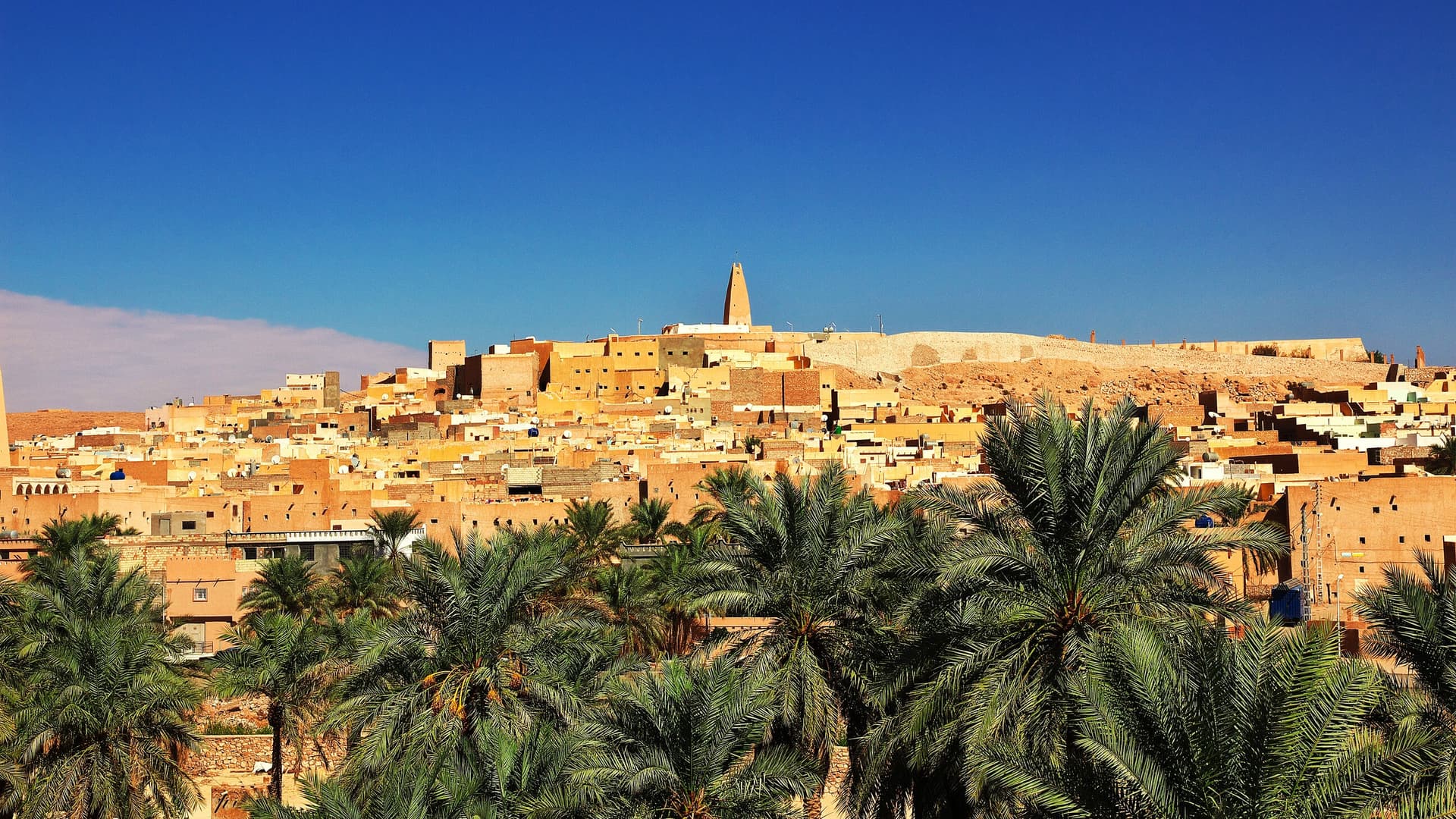
Mzab and Northern Sahara
Five Ibadi cities from the 11th century in the Mzab valley, Gourara oases irrigated by foggaras and the dunes of Grand Erg Occidental, just 1.5 hours by flight from Algiers.
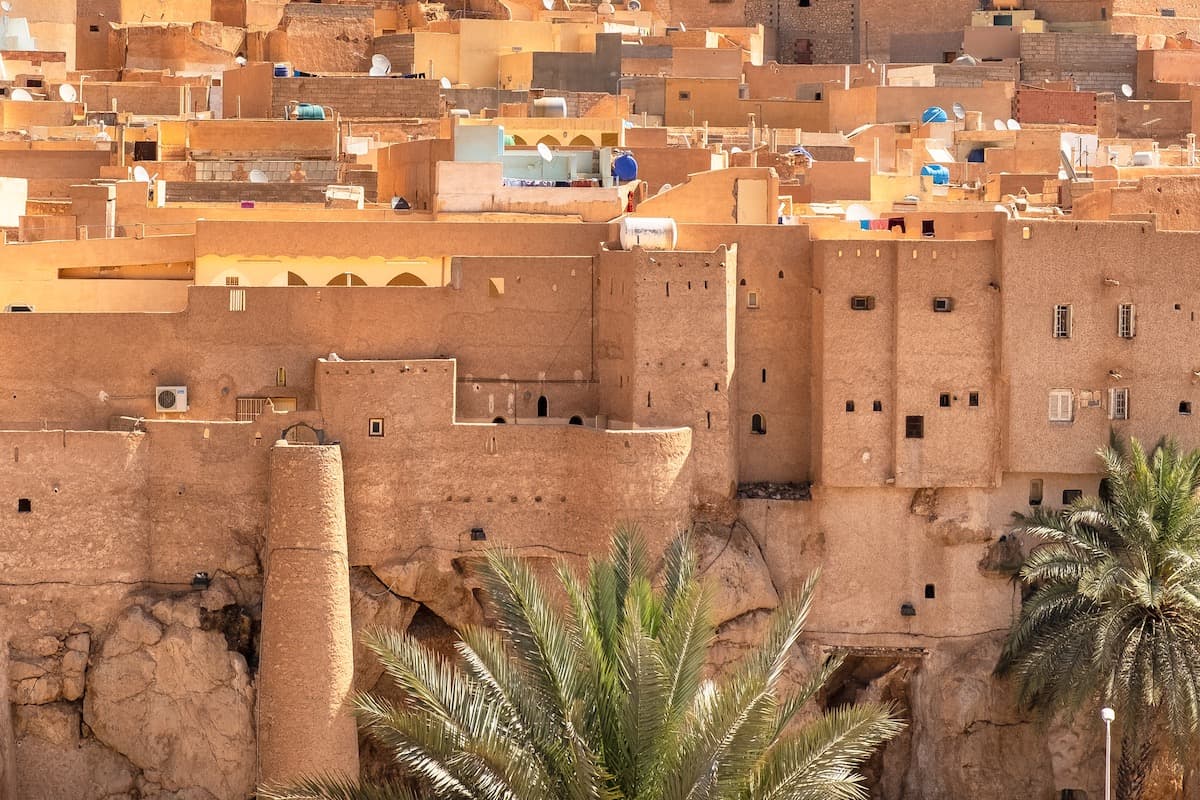
The Mzab Valley stretches for fifteen kilometres in a rocky basin in the north of the Sahara, 600 km south of Algiers. Five fortified cities were built there between the 11th and 14th centuries by the Ibadis, a minority branch of Islam driven toward the desert: Ghardaia, Beni Isguen, Melika, Bounoura and El Atteuf. Their concentric urban layout, organised around the mosque topped by a pyramidal minaret, inspired Le Corbusier and Fernand Pouillon. The entire ensemble has been UNESCO World Heritage listed since 1982.
Ghardaia concentrates commercial activity, with its arcaded market where carpets woven by Mozabite women according to geometric patterns passed down from mother to daughter are still traded. Beni Isguen remains the sacred city: entry is reserved for accompanied visitors, alcohol is forbidden, and the mid-afternoon auction market still operates according to rules set down seven centuries ago. In the narrow streets, women wear the white haïk revealing only one eye. This religious and social discipline has allowed the Mozabite community to preserve its identity at the heart of a hostile Saharan environment.
Water structures the entire region. The Mzab hydraulic system, developed in the 14th century, harnesses the rare flooding of the Mzab wadi through a distribution dam that allocates water between the date palm gardens according to rules still applied today. The 200,000 date palms in the Ghardaia palm grove produce notably the deglet nour, Algeria's most exported date. In the heart of the gardens, summer ksour where families retreat during the hot months testify to a seasonal organisation of habitat.
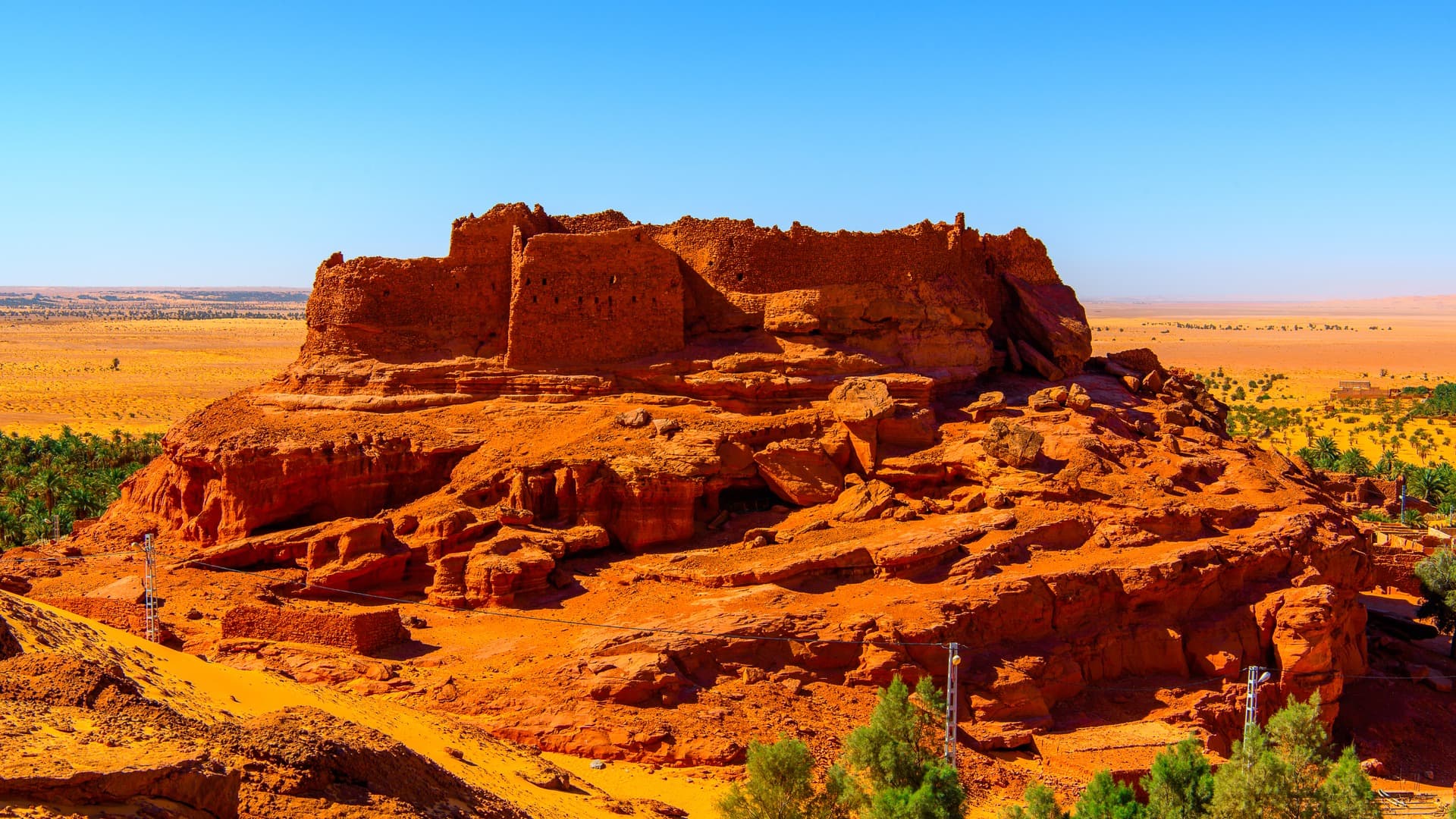
Four hundred kilometres west of Ghardaia, Timimoun opens onto a different Sahara. The red city, so named for its ochre raw earth constructions, overlooks a sebkha, a dried salt lake that turns pink at the end of the day. It is the gateway to Gourara, a region of 99 oases irrigated by foggaras, underground galleries of Persian origin that drain the water table over tens of kilometres. The ksar villages of Ouled Saïd, Massine and Tinerkouk retain their fortified granaries and zaouïas. Every March, the Sbouâ festival brings together Sufi brotherhoods for a week of chanting and processions around the mausoleum of Sidi El Hadj Belkacem.
Southwest of Timimoun, the Grand Erg Occidental unfolds its dunes over 80,000 km². The sand ridges reach 200 metres high near Taghit, another fortified oasis set at the foot of a cliff carved with petroglyphs dated to 6,000 years ago. The El Oued region, east of Mzab, presents a singularity: its palm groves are planted in hollows dug into the sand, the ghouts, to reach the water table without surface irrigation.
Economically, the region lives from traditional Mozabite commerce, whose networks extend throughout the country, from oasis agriculture and, since the 1960s, from gas and oil activities concentrated further south around Hassi Messaoud. Tourism remains modest and regulated, which preserves the authenticity of the cities and limits pressure on the sites.
To discover
Beni Isguen, the sacred Ibadi city. Accompanied visit mandatory through the white narrow streets where sculpted doors open onto interior courtyards. The late-afternoon auction market has been held since the 14th century according to the same ritual.
The palm grove and foggara system. Descent into a Gourara foggara with a local guide to understand how water circulates from the water table through 10 to 15 km of underground galleries, a technique inscribed on the inventory of intangible heritage.
Bivouac in the Grand Erg Occidental. Two nights under Berber tent at the foot of the dunes of Taghit or Tinerkouk, after a 4x4 approach from Timimoun. Overnight temperatures around 8 to 12°C in winter, unpolluted night sky.
Timimoun and its sebkha. Sunset from the corniche of the red city, when the dried salt lake turns pink and the surrounding ksour are illuminated. Characteristic Sudanese banco architecture of Gourara.
The Sbouâ festival in Timimoun. Seven days of Sufi processions in March around the mausoleum of Sidi El Hadj Belkacem, bringing together the brotherhoods of the 99 oases of Gourara. Chanting, banners, baroud dances.
When to go
The favourable season runs from October to April, with days of 20 to 28°C and nights dropping between 5 and 12°C in December and January. Plan warm clothing for evenings and bivouacs: temperature swings often exceed 20°C in the depths of winter. November, February and March offer the best compromise between daytime and nighttime comfort. Rain is rare, with a few brief episodes in autumn, but they can render certain tracks impassable for 24 to 48 hours.
From May to September, temperatures regularly exceed 40°C in Ghardaia and reach 45 to 48°C in Timimoun in July and August. We advise against Saharan circuits during this period, except for travellers accustomed to desert climate. The month of Ramadan, whose dates vary each year, modifies market and restaurant opening hours: we adapt programmes accordingly.
Practical advice
We recommend a minimum of 5 days on site: 2 days in the Mzab Valley to visit at least three of the five cities, 1 day for transfer or flight to Timimoun, 2 days in Gourara with one night under tent in the erg. A 7 to 8-day circuit allows you to add Taghit and its petroglyphs, or El Oued and its ghout palm groves. Ghardaia Airport (Noumérat) is served from Algiers in 1.5 hours by flight, several times a week. Timimoun also has an airport, which allows you to complete the circuit without returning by road.
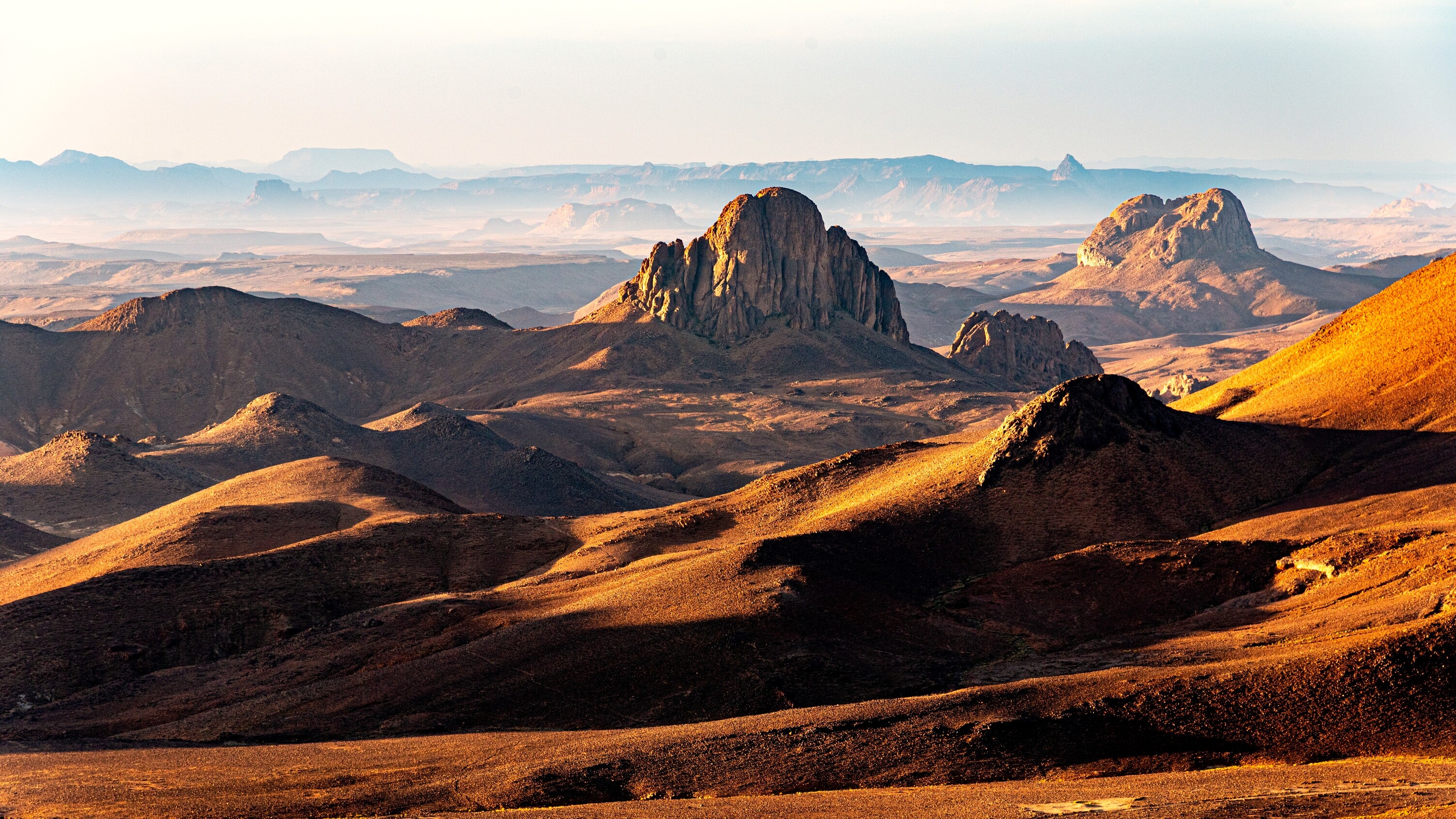
The region combines well with Algiers and the coast at the beginning or end of your stay, for city-desert contrast. Travellers with 15 days or more can continue to Hoggar and Tassili n'Ajjer, further south, accessible by domestic flight from Ghardaia via Tamanrasset or Djanet. Comfort on site is adequate without being luxurious: 3-star hotels in Ghardaia and Timimoun, traditional guesthouses in certain ksour, equipped bivouacs in the erg. The region suits travellers interested in architecture, anthropology and desert landscapes, in couples, between friends or as a family with children from 8 years old. It is less suited to hikers seeking elevation gain, who will find more to their liking in Hoggar.