Hoggar
"The Ahaggar is the southernmost part of the Algerian Sahara, situated approximately between the 20th and 25th parallels of the Northern Hemisphere and the 3rd and 7th degrees east of the Prime Meridian. The su
General Information about Hoggar (Ahaggar in Tamahaq)
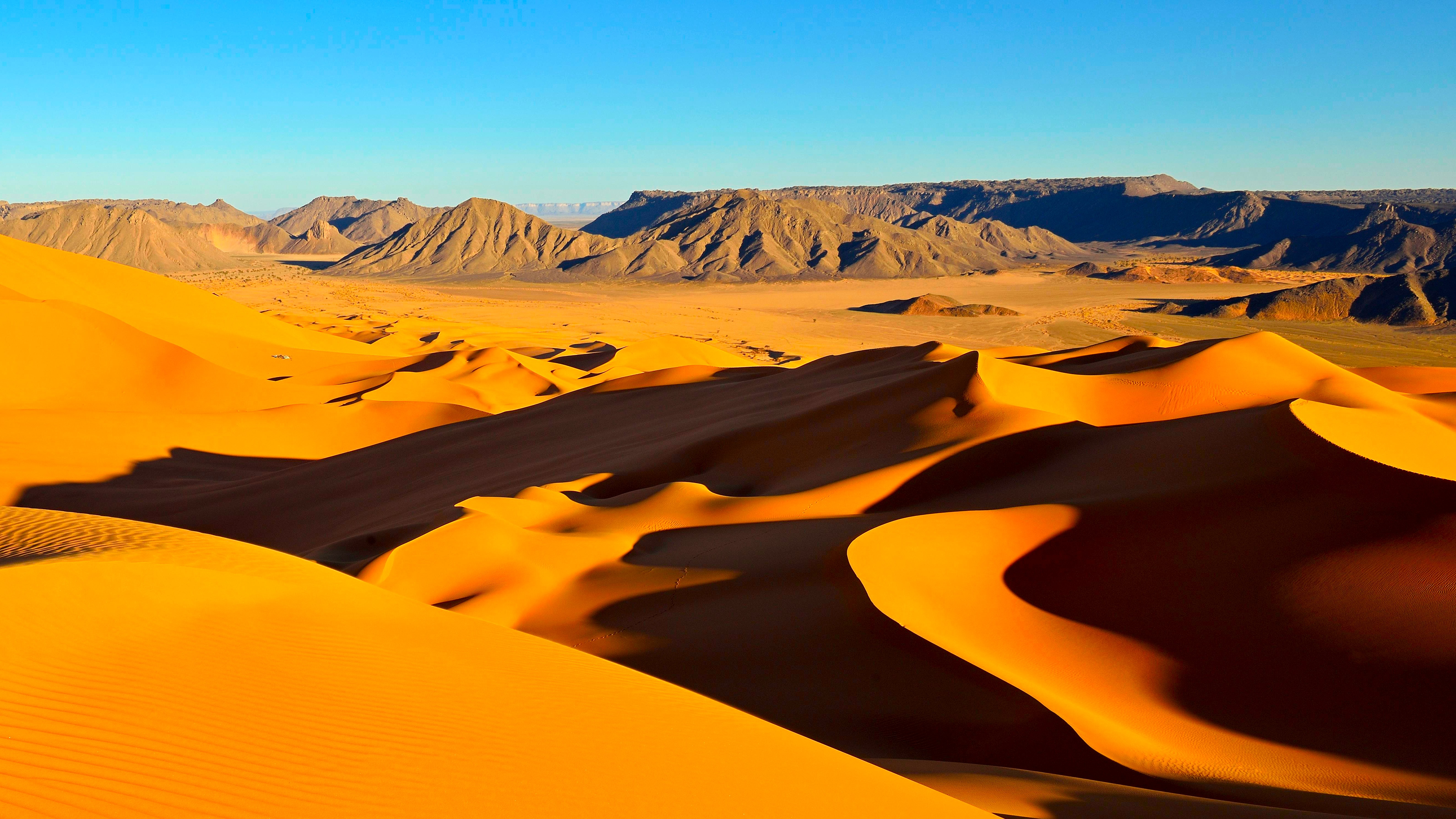
"The Ahaggar is the southernmost part of the Algerian Sahara, situated approximately between the 20th and 25th parallels of the Northern Hemisphere and the 3rd and 7th degrees east of the Prime Meridian. The Hoggar covers an area of 480,000 km². Tamanrasset, the administrative capital, is located 2,000 km south of Algiers (by road); the Tropic of Cancer sits approximately 85 km north of Tamanrasset.
The Ahaggar is bordered to the north by the Tidikelt and the Touat (In Salah is 700 km from Tamanrasset), to the east by the Tassili n'Ajjer (Djanet is 700 km away), to the south by Niger (Agadès is 900 km away), to the southwest by Mali (Kidal is 840 km away). The Tanezrouft borders the Ahaggar to the west, and the Ténéré bounds it to the southeast. The Algerian-Niger border is situated 430 km south of Tamanrasset, at In Guezzam.
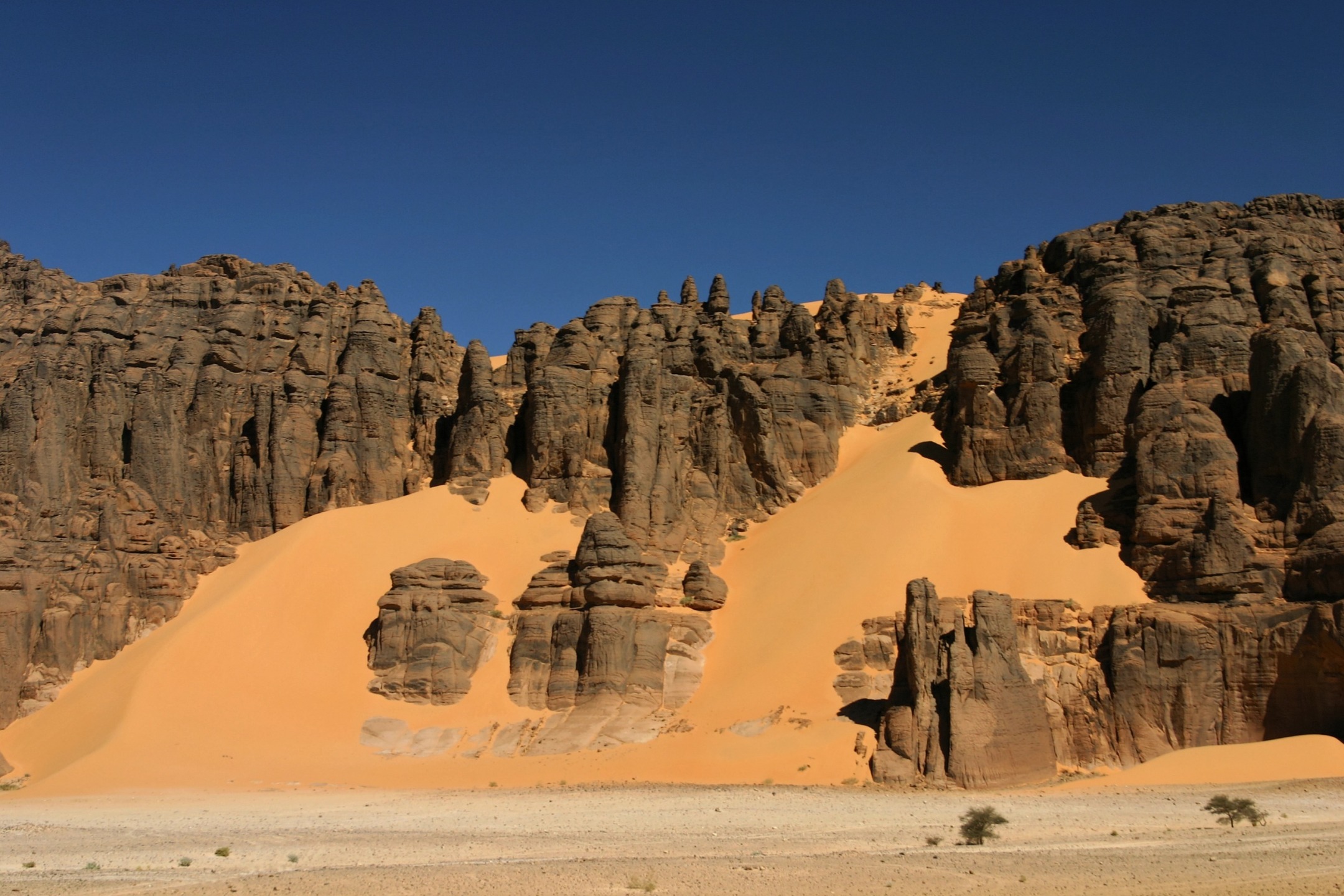
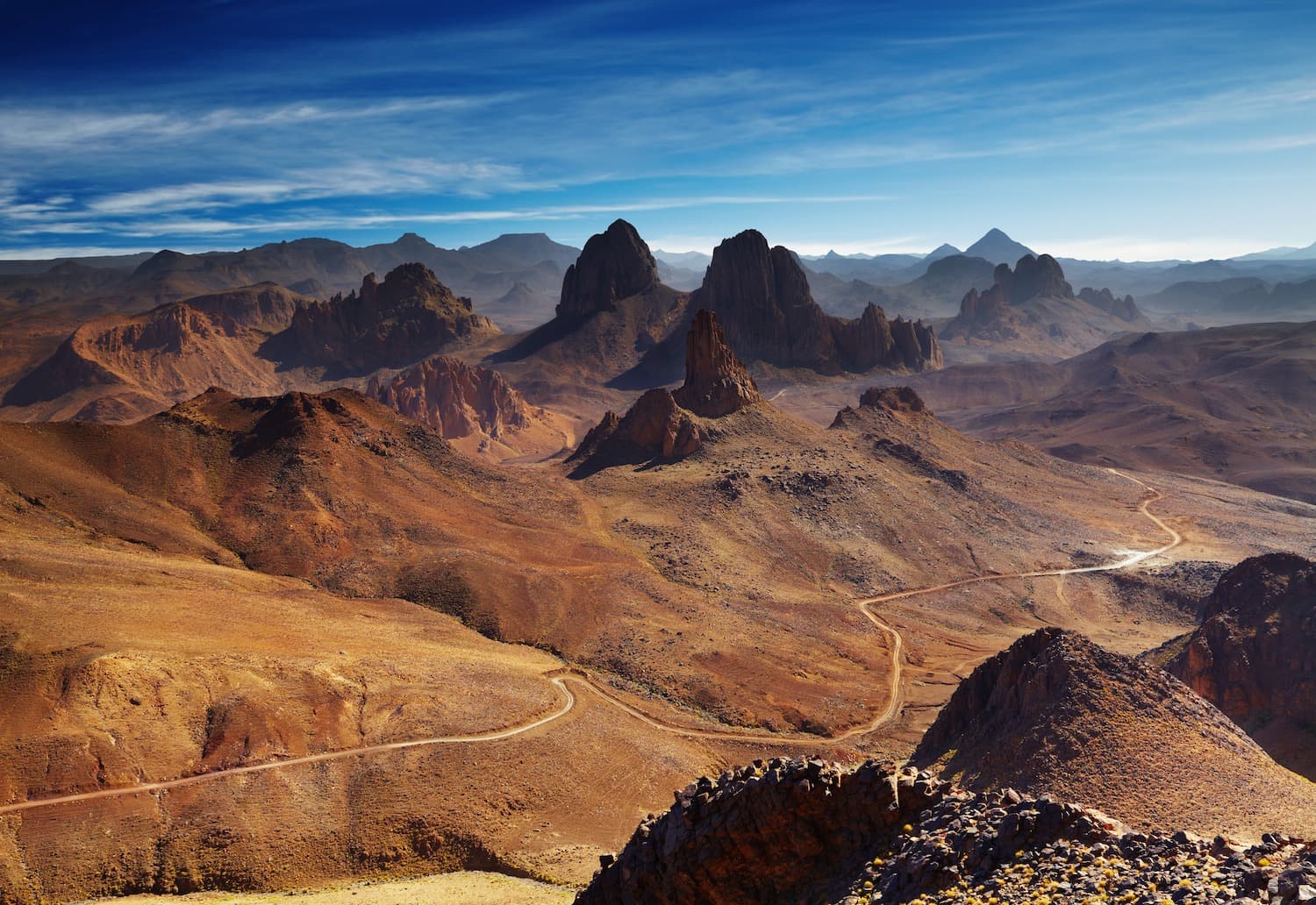
The heart of the Ahaggar is formed by a crystalline massif called Atakor in Tamahaq. Through this Precambrian bedrock emerged significant volcanic formations during the Tertiary and Quaternary periods, which give the Atakor panorama its grandiose aspect. The highest peaks approach 3,000 m, with many exceeding 2,500 m. Tahat reaches 2,918 m, Ilamane 2,760 m, and the Assekrem plateau 2,728 m. These extrusions, numbering nearly five hundred across an area of about 400 km², are formed either of alkaline phonolites or of trachytes, quartziferous or not. They traverse a series of subhorizontal basaltic flows that are roughly contemporary with them. The volcanism likely dates from the late Tertiary. The final basaltic manifestations are Quaternary and subrecent (valley flows)." (Marceau Gast).
Populations of the Ahaggar
"The demographic emptiness of the Ahaggar appears to be an ancient affliction in this land. Several facts from oral history and popular legends, particularly concerning the origin of the tribes, confirm this. The Kel Rela, the last reigning family, claim descent from a Berber queen who came from Tafilalet with her servant, and whose tombs are located near Abalessa (80 km northwest of Tamanrasset). Tin Hînan nearly starved before reaching the Ahaggar and came to settle peacefully in this region, which she found empty or nearly so. Indeed, a few idolaters, the Isebeten (Issebetènes), inhabited the Taessa massif, the most inaccessible part of the Atakor. Tin Hînan is said to have given birth to the Kel Rela. Takama, the servant, is said to be the ancestor of three important tribes: the Dag Rali, the Aït Loaien, and the Kel Ahnet. Whatever the value of the above legend, oral tradition indicates the existence of the Issebetènes, very primitive and idolatrous people, lacking in combativeness and few in number, completely isolated. Certain individuals among the Dag Rali, though with discretion, still today claim descent from the Issebetènes." (Marceau Gast).
Our various circuits through central Hoggar traverse mainly the territories of the Dag Rali and Adjouh n'Téhélé tribes. "The Adjouh n'Téhélé fled from the Aïr (In Gal) between 1750 and 1800, leaving some of their people who are now called the Kel Arafsa" (Marceau Gast). A well-defined territory was assigned to them in the Hoggar since that time. The Dag Rali and Adjouh n'Téhélé tribes, being geographically very close, have established numerous kinship ties between themselves.
The citations from Marceau Gast are taken from the work "Alimentation des populations de l'Ahaggar" (Memoirs of C.R.A.P.E, Algiers. Arts and Métiers Graphiques, 1968).
Hoggar National Park
All journeys we schedule in the Tassili are located within the park, and we are obligated to respect its regulations. All visitors must complete a form, and Détours Algérie pays an entrance fee (included in the travel package) that is used for site maintenance.
Flora
Words written in italics are in Tamahaq. We specify when they are Arabic words (ar.).
Central Sahara possesses a flora far from negligible. One need only look around during travels to be convinced of this. Trees and shrubs, often thorny, can resist drought for several years. Numerous ephemeral plants grow practically everywhere in the bottoms of wadis, on plateaus where a little soil remains, among the dunes of ergs and on their slopes as soon as rains of some importance, and better still, recurring rains, fall on the land. These plants are the most important pasture for Saharans, who call it akasa or acheb (ar.). The most frequently encountered trees are acacias of different species: Acacia raddiana or abser and talha (ar.), Acacia ehrenbergiana or tamat, and Acacia albida or ahates. In mountain wadis, two tamarisks are also found (tabarakat and azawa), a thorny plant, the taboraq or in Arabic atil (Maerua crassifolia), the telokat which is a fig, the tabakat, which is a jujube (Ziziphus lotus).
Everywhere grows the Apple of Sodom (Calotropis procera) or torha. Plants and bushes are particularly adapted to lack of moisture. They ensure the survival of domestic and wild animals during long periods of drought. One can mention, particularly liking sand, the arassou (Caligonum comosum), the touloult (Aristida pungens, drinn or sbot depending on the region in Arabic), the famous tahara or had (ar.) of Arab nomads (Cornulaca monocantha), the aginast (Moltkia ciliata) with small blue flowers.
On the plateaus, in the wadis, and in the mountains, grow: the tassa (Anabasis articulata) which burns even when wet, the aramas (Atriplex halimus), and the issin (Salsola foetida) which provide salt to animals, as does the tamarisk, the afazou (Panicum turgidum, Mrokba, ar.) with cruel spines, the ana or anag (Leptadenia pyrotechnica).
Ephemeral plants that appear with rains are, among the most common: the tanetfert (Pulicaria crispa) which gives a bitter taste to the meat and milk of animals that graze on it, the tahana (Heliotropium ondulatum), the alouat (Schouwia purpurea), the taïnast (Echium humile), the alka (Trichodesma agricanum) with a borage-like appearance, the egzei-fuk (Lupinus tassilicus) with magnificent blue flowers, etc…
Fauna
Words written in italics are in Tamahaq. We specify when they are Arabic words (ar.).
Heavily hunted, large animals tend to disappear. This is the case with the gazelle and the wild sheep (mouflon), the latter resisting better because it can hide in the mountains. Carnivores are still present: jackal (ebegi), hungry fox, fennec, wild cat (Felix sylvestris).
As for rodents, they remain numerous. One can note jerboas and gerbils, mole rats, gundis, and various species of rats and mice. The family of hyraxes is represented by small colonies of rock hyraxes which, as their name indicates, live in rocks, not far from wadis where they can find their food, particularly acacia leaves.
The family of lagomorphs is represented by the Cape hare.
Lizards are numerous. One can note several varieties of agamas called el rechaba, geckos or amatartar and tamekwart, the whiptail lizard or Uromastix which is the agezeram of the Tuareg or the dob of the Arabs, the desert monitor arata, which is the largest of Saharan lizards. The most frequent lizards are smaller and mostly belong to the family of Acanthodactyles.
Snakes are primarily represented by two dangerous species:
- The horned viper (Cerastes vipera) which, as its name indicates, lives in sandy regions, particularly in ergs.
- The horned viper (Cerastes cerastes) which prefers stony wadis.
These two species hunt at night and enter hibernation during the cold period. Colubrids are encountered fairly often. The most frequent species is the Sand Snake (Psammophis shokari). In Tamahaq, the viper is called tachelt (ar. lefaâ), and the colubrid achel.
Scorpions also appear with the heat.
Birds that are frequently observed include ravens, always on the lookout for food remains left at camps, the white-crowned wheatear, the famous moula-moula of the Tuareg. There is also the fierce buzzard, the falcon (tamida), the owl (bouhan). At night, one can hear the screech owl (tawik).
Rock Engravings and Paintings
We recommend discovering online the excellent feature produced by Denis Lionnet on the FuturaSciences website: http://www.futura-sciences.com/comprendre/d/dossier232-1.php. Denis Lionnet is also the designer of the website www.ennedi.free.fr, the reference in French on the subject.