Ahnet and Immidir
These tassilis form the northern and northwestern quarter of the sandstone belt surrounding the Hoggar. Between Tamanrasset and In Salah, they constitute a powerful sandstone barrier carved by canyons and gorges, the most famous of which are those of Arak.
These tassilis form the northern and northwestern quarter of the sandstone belt surrounding the Hoggar. Between Tamanrasset and In Salah, they constitute a powerful sandstone barrier carved by canyons and gorges, the most celebrated of which are those of Arak. Immidir is a massive citadel that proves difficult to traverse, while Ahnet comprises a multitude of small plateaus—some compact, others partially sand-covered. Unlike its neighbor Immidir, Ahnet lacks significant oases, cultivation, or gueltas; it is more mineral, more arid. Its understated and more open relief permits relatively easy access to all its treasures.
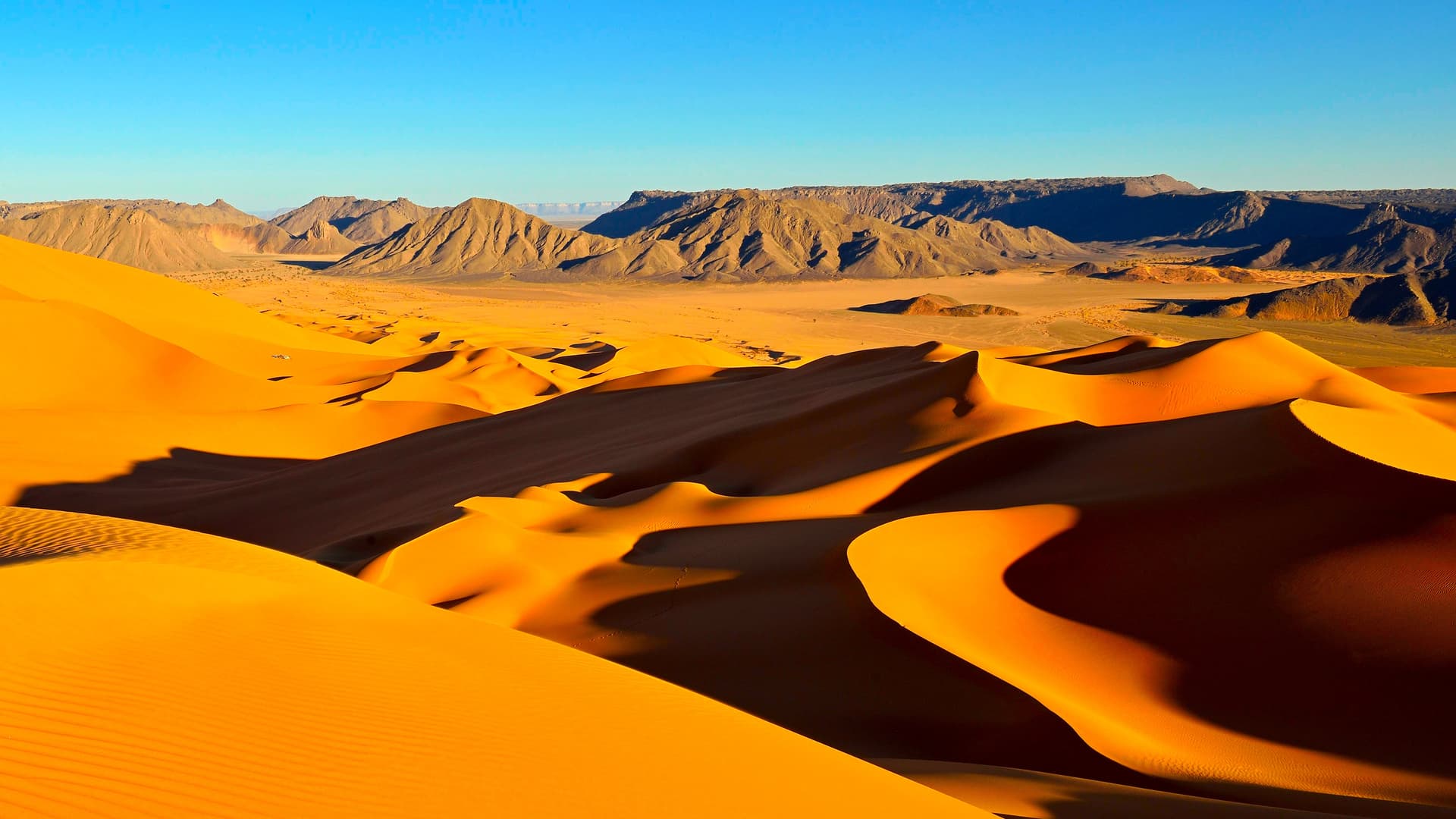
On the western face of Immidir, the small tassili of Ti-m-Meskis rests upon the sands of the erg Mehedjibat, whose beauty perhaps has no equal in the Sahara.
The landscapes, rock art, and atmosphere of these massifs rival other, better-known and more frequented tassilis. Far from the crowds, the pleasure of discovery and silence await.
Geomorphology
"In essence, a land of Immidir and Ahnet with tabular architecture, where the aftereffect of the Atlas uplift was felt energetically; faults, joint fractures, and Tertiary posthumous folds followed the directions imposed upon them by primary folds and faults...
Across the plateaus, the oueds are extremely picturesque, having carved themselves narrow canyons with perpendicular walls of bare sandstone, sometimes very high. These wild gorges are not merely superb material for photographs; they hold a certain food-related interest for the Tuareg—proof of which lies in observations at certain privileged points of clusters of rock engravings, the most durable trace of ancient frequentation...
Symmetry between what might be called two twin organisms; Mouidir and Ahnet each represent a distinct semicircular collapse basin, or if you prefer, a syncline basin closed to the south. In both lands, all the slopes of the hammadas converge in a funnel section toward a center marked by the presence of Quaternary deposits and dunes.
The ergs Enfous and Tessegafi correspond exactly to the ergs Tegant and Iris... between the two regions the only difference is elevation, but it is considerable." (E. F. Gauthier, "Sahara", 1908).
Ahnet and the Europeans
The first European to brush past Ahnet was Major Laing, en route to Timbuktu, who skirted Ahnet in 1826 along the age-old Tidikelt trail to Mali. Seventy-seven years later, in 1903, the second European, Commandant Laperrine, led a military reconnaissance making a wide loop through the massif.
These reconnaissances thereafter multiplied; Th. Monod spent nearly a year there in 1929, producing several thematic monographs that remain references today. H&M traversed this massif on several occasions following an initial expedition in 1987.
Tuareg of Ahnet
Ahnet falls under the exclusive suzerainty of a noble Tuareg tribe, the Taïtoq; it is inhabited by them and by imrads, the principal of which are the Kel Ahnet (people of Ahnet)... The Taïtoq are one of three families or noble tribes that share authority within the Hoggar confederation, and they trace themselves, like the other two, to the common ancestress Tin Hinan, buried at Abalessa in a fine megalithic tomb. The Kel Ahnet also claim descent from an ancestress common to the Dag R'ali, the most prominent of the imrad tribes of Hoggar; this ancestress is Takamat, herself buried at Abalessa beside Tin Hinan in a turret-form redjem. All these people thus have Abalessa as their homeland, where they keep their family tombs. The Taïtoq fell out with the other great noble tribe, the Kel R'ela; it is this old, often bloody rivalry between Kel R'ela and Taïtoq that gives Ahnet a distinct life, a political individuality... Arabic is widely spoken in Ahnet, which is far from the case in Hoggar. This serves as an individualizing principle for the people of Ahnet.
The submission of the Taïtoq to French authority preceded that of other Tuareg, doubtless because, with a more open spirit, they grasped the new situation more quickly. The Taïtoq and their imrads nonetheless remain intimately bound to the common life of the Hoggar confederation of which they are part. Geographically, it would moreover be impossible for them to abstract themselves from it. The pastures of Ahnet, like all those of the Sahara, are too uncertain to count on exclusively. Taïtoq and Kel Ahnet own or hold usufruct over vast districts in the Adrar des Iforas (Mali), where they neighbor the Kel R'ela. (E. F. Gauthier, "Sahara", 1908).
Flora
Words in italics are in Tamasheq. We note when words are in Arabic (ar.).
Central Sahara possesses a flora far from negligible. One need only look about during travels to be convinced of it. Trees and shrubs, often thorny, can resist dryness for years. Numerous ephemeral plants grow practically everywhere in wadi beds, on plateaus where some soil remains, among the dunes of the ergs and on their slopes whenever rains of any consequence, better yet recurring rains, fall upon the land. These plants constitute the most important pasture for Saharan peoples, who call it akasa or acheb (ar.). The trees encountered most often are acacias of various species: Acacia raddiana or abser and talha (ar.), Acacia erhenbergiana or tamat, and Acacia albida or ahates. In mountain wadis, one also encounters two tamarisks (tabarakat and azawa), a thorny shrub, taboraq or in Arabic atil (Maerua crassifolia), the telokat, which is a fig, tabakat, which is a jujube (Ziziphus lotus).
Everywhere grows the Apple of Sodom (Calotropis procera) or torha. Certain plants and shrubs are particularly adapted to moisture scarcity. They ensure the survival of domestic and wild animals during long periods of drought. One might cite, showing particular affinity for sand, arassou (Caligonum comosum), touloult (Aristida pungens, drinn or sbot depending on the region in Arabic), the famous tahara or had (ar.) of Arab nomads (Cornulaca monocantha), aginast (Moltkia ciliata) with small blue flowers.
On plateaus, in wadis, and in mountains grow: tassa (Anabasis articulata), which burns even when wet, aramas (Atriplex halimus), and issin (Salsola foetida), which provide salt to animals, as do tamarisks, afazou (Panicum turgidum, Mrokba, ar.) with its cruel thorns, ana or anag (Leptadenia pyrotechnica).
Ephemeral plants appearing with rains include, among the most common: tanetfert (Pulicaria crispa), which imparts a bitter taste to the meat and milk of grazing animals, tahana (Heliotropium ondulatum), alouat (Schouwia purpurea), taïnast (Echium humile), alka (Trichodesma agricanum) resembling borage, egzei-fuk (Lupinus tassilicus) with magnificent blue flowers, and so on.
Fauna
Words in italics are in Tamasheq. We note when words are in Arabic (ar.).
Heavily hunted, large animals tend to disappear. This is the case with gazelles and mouflon, the latter resisting better as it can hide in the mountains. Carnivores remain present: jackals (ebegi), lean foxes, fennecs, wildcats (Felix sylvestris).
As for rodents, they remain numerous. One can note jerboas and gerbils, meriones, gundis, and various species of rats and mice. The procacanid family is represented by small colonies of rock hyraxes, which, as their name indicates, live among rocks not far from wadis where they find food, particularly acacia leaves.
The family of lagomorphs is represented by the Cape hare.
Lizards are abundant. One can note several varieties of agamas called el rechaba, geckos or amatartar and tamekwart, the spiny-tailed lizard or Uromastix, which is the agezeram of the Tuareg or the dob of the Arabs, the desert monitor, arata, the largest of Saharan lizards. The most frequent lizards are smaller and mostly belong to the Acanthodactyles family.
Snakes are chiefly represented by two dangerous species:
- The sand viper (Cerastes vipera), which, as its name indicates, lives in sandy regions, particularly in ergs.
- The horned viper (Cerastes cerastes), which prefers rocky wadis.
Both species hunt at night and enter hibernation during the cold season. Colubrids are encountered fairly often. The most common species is the Sand Snake (Psammophis shokari). In Tamasheq, the viper is called tachelt (ar. lefaâ), and the colubrid achel.
Scorpions also appear with the heat.
Birds that are frequently noticed are ravens, always on the lookout for food scraps left at bivouacs, the white-crowned wheatear, that famous moula-moula of the Tuareg. There is also the fierce buzzard, the falcon (tamida), the owl (bouhan). At night, one can hear the eagle-owl (tawik).
Rock Engravings and Paintings
We recommend you discover on the Internet the excellent dossier created by Denis Lionnet on the FuturaSciences website: http://www.futura-sciences.com/comprendre/d/dossier232-1.php. Denis Lionnet is moreover the designer of the site www.ennedi.free.fr, the French-language reference on the subject.