Ajjer and Djanet
The Algerian Tassilis (a Tamahaq word designating vast, bare plateaus, more or less fractured) are composed of series of sandstone of marine origin, dating from the primary era. Their thickness reaches nearly 600 meters in some places.
The Algerian Tassilis (a Tamahaq word designating vast, bare plateaus, more or less fractured) are composed of series of sandstone of marine origin, dating from the primary era. Their thickness reaches nearly 600 meters in some places. At times the granite bedrock appears, for example in the surroundings of Djanet. Several tassilis, differentiated by erosion, encircle the recent volcanic massif of the Hoggar, which uplifted and pierced through them. These are to the East and Northeast, the Tassili n'Ajjer (1906m), to the North, the Immidir (1684m), to the Northwest, the Ahnet, to the Southwest, the Tassili of Tim Missao, to the Southeast and South, that of the Ahaggar (1007m). Ajjer and Immidir are the most important and the highest.
"The Tassili Plateau extends over 750 km in length with a width varying from 60 to 100 km. Its area is 350,000 km². On the map, the Ajjer region emerges from the sands that surround it on most of its perimeter: to the East, the Libyan sand seas, the Mourzouk Erg and that of Oubari, to the South, the immense Ténéré desert and the Admer Erg, to the North, the Issaouane Erg and the Bourharet Erg." Blue Guide to the Sahara 2000 (Hachette Editions).
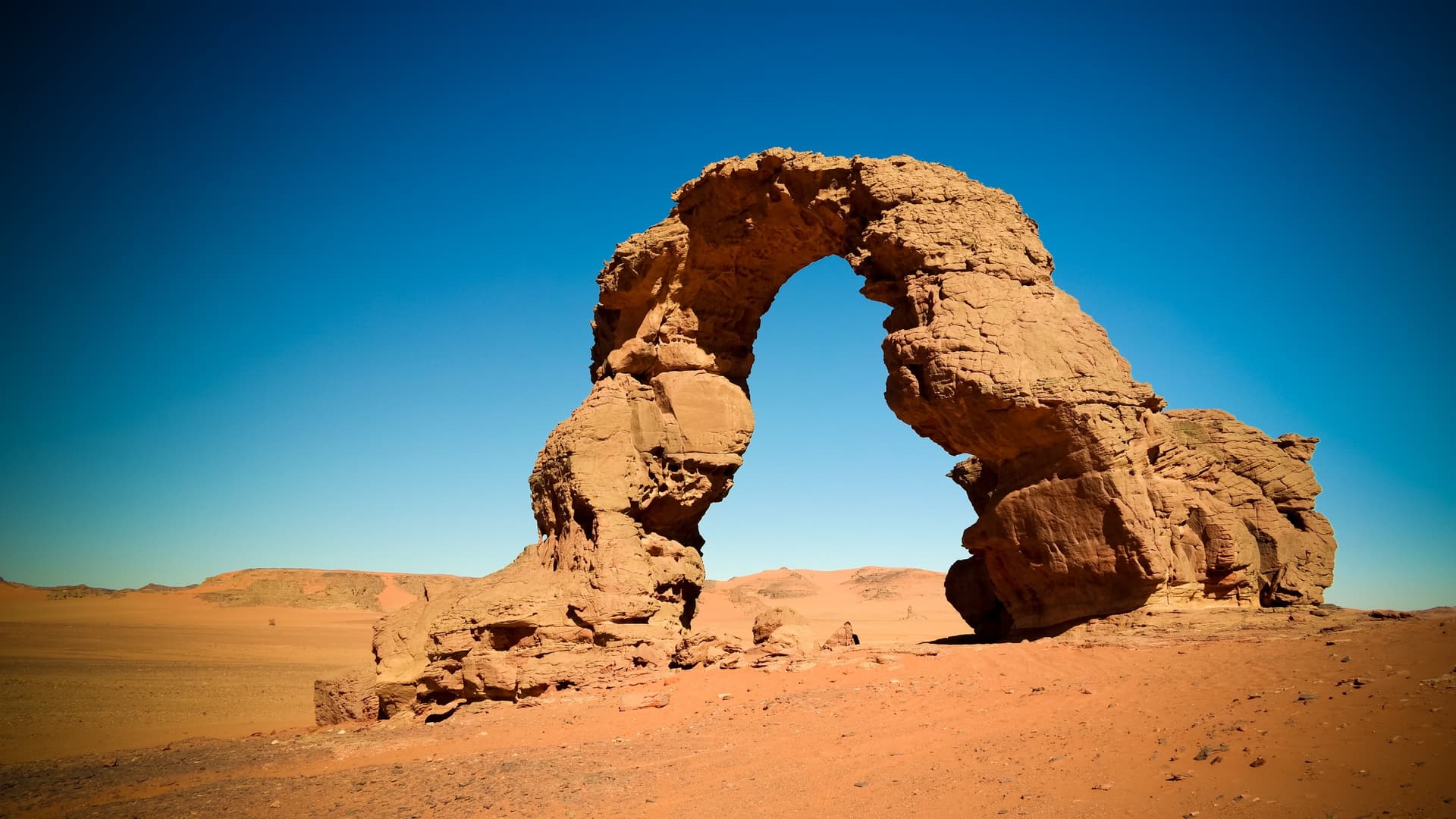
This region has inspired many authors; one imagines that Picasso or Gaudí must have wandered among these landscapes frozen in stone. One of them shares his impressions: "…scattered here and there are mysterious assemblies of rocks that nature has molded into the most capricious forms, and that erosion has rendered even more tormented. The appearance of these forests of rocks does not fail to provoke, even in the most forewarned traveler, a powerful impression where hallucination mingles with wonder, the tragic with the magical. From these rocks that rear up, bristle, spread out, swell, jostle in chaotic alignments, a thousand phantasmagoric visions surge: cathedrals, legendary castles, baroque palaces, dead cities, titanic sanctuaries, beached ships, antediluvian monsters protected by a thick rough carapace, in short an abundance of suggested images, a mass of raw forms in a boundless space, visited only by the wind." Jean-Dominique Lajoux.
Rock Paintings
"It was in 1909 that an officer, Captain Cortier, detected their presence and reported the first discovery of prehistoric art on the Tassili n'Ajjer. Then came the discoveries by Lanney, Conrad Kilian and Bernard; but it was not until the 1930s that the importance of this Saharan prehistoric art center became apparent, thanks to the discoveries of another military man, Captain Brenans." (J.D. Lajoux).
Since the mission of Henri Lhote and his team in 1956, which was tasked with recording the entire rock art ensemble, the art of the Tassili has acquired a well-deserved worldwide reputation. These paintings, the oldest of which are roughly contemporary with the beginnings of domestication, span more than 7,000 years, with the most recent being nearly contemporary. "The variety of subjects and especially of styles demonstrates diverse artistic groups, localized geographically, and accompanied by certain fauna, with special types of characters, using certain weapons, etc.
These artistic groups – or "schools" – in turn reflect, in a manner that is undoubtedly complex and non-univocal, concrete ethnic groups limited spatially, situated chronologically, and possessing, in addition to special artistic traditions, different symbolic foundations. The classification and chronology of these schools are established according to various formal criteria (execution techniques, styles, superpositions, patinas) and also according to depicted themes (physical types of characters, fauna, weapons)." Alfred Muzzolini in Rock Art of the Sahara (1995).
These rock paintings and engravings testify to the presence of numerous populations and animals, and therefore to past periods of greater humidity.
Rock Engravings and Paintings
We recommend discovering online the excellent dossier created by Denis Lionnet on the FuturaSciences website: http://www.futura-sciences.com/comprendre/d/dossier232-1.php. Denis Lionnet is also the designer of the site www.ennedi.free.fr, the French-language reference on the subject.
Djanet (1050 m)
A small oasis just a few years ago, Djanet has developed considerably. Four villages once formed it: Adjahil, on the right bank, and El Mihan, Tin Khatma and Azelouaz, at the foot of the Tim Beur mountain, on the left bank. Houses increasingly climb the rocky and steep edges of the wadi, now linking the old quarters to each other and spreading into adjacent valleys. The palm grove and gardens remain constantly at the mercy of the wadi's sometimes very violent floods.
Since 1999, the paved road has opened up Djanet.
The Guide and Camel Herders
They are Ajjer Tuaregs generally belonging to the Kel Medak tribe. Most now live in Djanet, in a new neighborhood located north of the oasis, in In Abarbar. Only a few Kel Medak encampments remain truly nomadic. Tuaregs speak a Berber language called, depending on the region, Tamahaq or Tamacheq. Generally, they also know Arabic, which is the official language in Algérie. Few speak a few words of French. All Tuaregs are Muslim.
Flora
Words written in italics are in Tamacheq. We specify when they are Arabic words (ar.).
The Central Sahara possesses a flora far from negligible. One need only look around during our travels to be convinced of this. Trees and shrubs, often thorny, can resist drought for several years.
Numerous annual or perennial plants grow practically everywhere in the beds of wadis, on plateaus where a little soil remains, between the dunes of ergs and on their slopes as soon as rains of some importance, and better yet, repeated rains, fall on the land. The pasture most sought after by Saharans, akasa or acheb (ar.), is composed of varied plants that grow quickly after rains.
The trees most frequently encountered are acacias of different species: Acacia raddiana or abser and talha (ar.), Acacia erhenbergiana or tamat and Acacia albida or ahates.
In mountain wadis, one also encounters two tamarisks (tabarakat and azawa), a thorny plant, the taboraq or in Arabic atil (Maerua crassifolia), the telokat which is a ficus, the tabakat, which is a jujube (Ziziphus lotus).
Plants and shrubs are particularly adapted to moisture deficit. They ensure the survival of domestic and wild animals during long periods of drought. One can cite, in sandy substrate, the arassou (Caligonum comosum), the touloult (Aristida pungens, drinn or sbot depending on the region in Arabic), the famous tahara or had (ar.) of Arab nomads (Cornulaca monocantha), the aginast (Moltkiopsis ciliata) with small white and pink flowers.
On the plateaus, in the wadis and in the mountains, grow: the bandar (Anabasis articulata) which burns even when wet, the aramas (Atriplex halimus) and the issin (Salsola foetida) which provide salt to animals, as do the tamarisk, the afazou (Panicum turgidum or mrokba, ar.), the ana or anag (Leptadenia pyrotechnica).
Ephemeral plants that appear with rains are, among the most common: the tanetfert (Pulicaria crispa) which gives a bitter taste to the meat and milk of animals that graze on it, the tahana (Heliotropium ondulatum), the alouat (Schouwia purpurea), the taïnast (Echium humile), the alka (Trichodesma agricanum) with a borage-like appearance, the egzei-fuk (Lupinus tassilicus) with magnificent blue flowers, etc.
Isolated from their region of origin, many plants have become endemic. The wild olive or Duprez cypress or Antinea lavender are remarkable representatives.
Fauna
Words written in italics are in Tamacheq. We specify when they are Arabic words (ar.).
Heavily hunted, large animals tend to disappear. This is the case with the gazelle and the mouflon, the latter resisting better as it can hide in the mountains. Carnivores are still present: jackal (ebegi), famished fox, fennec, wildcat (Felix sylvestris).
As for rodents, they remain numerous. One can note jerboas and gerbils, meriones, goundis, various species of rats and mice. The family of procaniids is represented by small colonies of rock hyraxes which, as their name suggests, live in rocks, near wadis where they can find food, particularly acacia leaves.
The family of lagomorphs is represented by the Cape hare.
Lizards are numerous. One can note several varieties of agamas called el rechaba, geckos, or amatartar and tamekwart, the whip-tailed lizard or Uromastix which is the agezeram of the Tuaregs or the dob of the Arabs, the desert monitor lizard, arata, which is the largest of the Sahara's lizards. The most frequent lizards are smaller and mostly belong to the family Acanthodactyles.
Snakes are mainly represented by two dangerous species:
- The sand viper (Cerastes vipera) which, as its name suggests, lives in sandy regions, particularly in ergs.
- The horned viper (Cerastes cerastes) which prefers rocky wadis.
Both species hunt at night and enter hibernation during the cold period. Colubrids are encountered fairly often. The most frequent species is the Sandsnake (Psammophis shokari). In Tamacheq, the viper is called tachelt (ar. lefaâ), and the colubrid achel.
Scorpions also appear with the heat.
Birds that are frequently seen are ravens, always on the lookout for food scraps left at camps, the white-crowned wheatear, the famous moula-moula of the Tuaregs. There is also the fierce buzzard, the falcon (tamida), the owl (bouhan). At night, one can hear the scops owl (tawik).
The Tassili National Park
All the trips we organize in Ajjer are located within the Park, and we are required to respect its regulations. Every visitor must complete a form and Détours Algérie pays an entrance tax (included in the trip package) which is used to maintain the sites.
Geology
"… the Tassili bars the Ajjer Sahara with a great dark ribbon, with an average width of 120 km. It extends from northwest to southeast following the Immidir (Mouydir), from which it is separated only by the Irarar gorge.
This mountainous plateau is formed of horizontal sandstone dating from the Lower Devonian or the end of the Silurian. These sandstones are deposited on crystalline terrain which they cover discordantly, strongly folded and whose age is fairly difficult to fix rigorously." Gabriel Gardel (The Ajjer Tuaregs, ERS, University of Algiers, 1961).