Tips for a Future Meharist in Tuareg Country
1. The Camel: Friends in Tamashek
1. The Camel: Friends in Tamashek
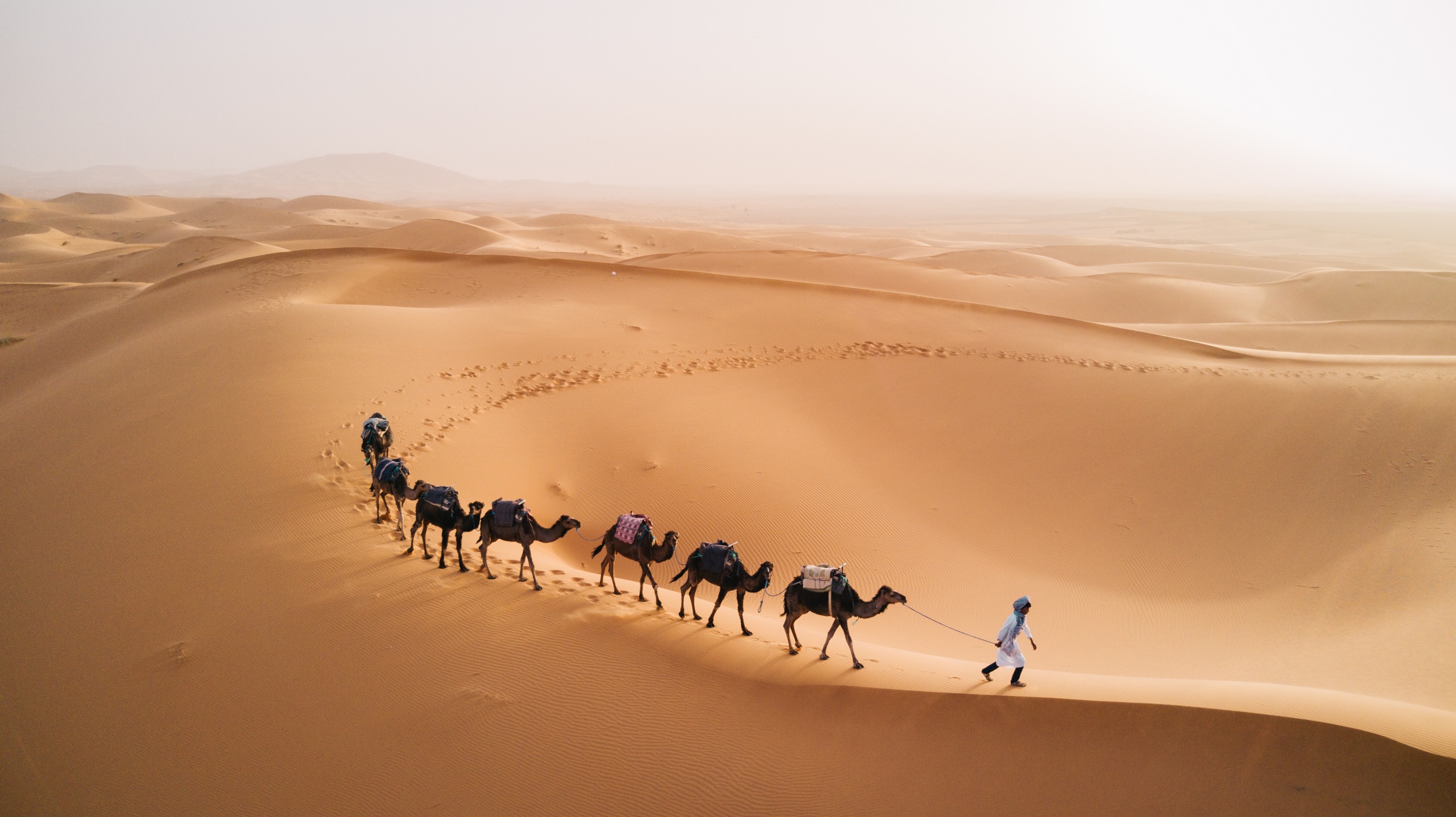
On the first day of your camel trek, each rider is entrusted with a camel and its harness.
- A saddle: tarik.
- Two or three saddle blankets: isetfar.
- A rein: tarant.
- A hobble: tefart.
2. The Saddle: Tarik
It consists of a seat with a cross at the front and a backrest at the rear. This saddle is positioned just in front of the camel's hump, secured by a girth around the animal's belly.
When mounted, avoid leaning back against the saddle backrest and keep your torso upright.
3. How to Mount the Camel
With the camel "baraqué"—that is, lying down with its legs folded—always approach from the left side. Your left hand grasps the cross of the saddle at its base, close to the seat. Your right hand takes support on the top of the backrest. Then swing your right leg between the cross and the backrest. Once in the saddle, immediately place your feet on the camel's neck.
It is important to:
- Never grip the branches of the cross, as they are very fragile and break easily.
- Always place the middle of your foot on the camel's neck, not the toe, which tends to slip.
- Ideally, go barefoot. Socks tend to slip and throw you off balance.
The animal rises by first extending its hind legs. Avoid losing your balance by pressing firmly on the neck. Then the front legs straighten—though this poses fewer challenges for the first-time meharist!
4. The Rein: Tarant. How to Guide Your Camel?
For a camel used exclusively for riding, the rein is typically fixed to a metal ring piercing the animal's right nostril and running under its neck, held on the left side of the head.
For a baggage camel, and sometimes even a riding camel, the rein uses a slip knot around the animal's lower jaw and tongue. This rein is called an akala.
- To move forward, give light tugs on the neck with the foot placed furthest forward.
- To turn right, gently pull the tarant to the right. To turn left, do the same toward the left.
- To stop the animal, pull the rein firmly backward, but not violently.
- On descents, raise the camel's head by shortening the tarant and keeping it horizontal, pressing firmly on the neck with your feet. Extend and stiffen your forward leg to prevent the saddle from sliding forward. You can also grip the tuft of hair covering the hump with one hand.
- On ascents, by contrast, lean forward and allow slack in the rein so the camel can extend its neck for the effort.
5. How to Dismount
- Lead the animal to an area free of rocks.
- Shorten the tarant, pull downward while pressing firmly on the neck several times, making the sound "che-che-che".
- The animal kneels. Continue pressing firmly with your feet and give slack to the tarant.
- The camel completes lying down with its hind legs.
- Always dismount on the left side, swinging your right leg over the saddle cross.
Then:
- Remove any gear hanging from the saddle.
- Unfasten the saddle and set it carefully on the ground.
- Remove the saddle blankets.
- Hobble the animal at its front legs.
- Remove the tarant.
IMPORTANT
- At the beginning and throughout your entire trek, you should never mount or dismount alone. Your Tuareg guides will always be there to help and advise you.
- Experience has shown us that many of you would like to mount and dismount independently, direct your camel somewhat independently of the caravan, make it trot or even gallop. However, this is not possible, and you will understand why after these important clarifications.
- The Tuareg are concerned you may fall and injure yourself. While they would certainly be worried for your sake, they also risk professional consequences. For your safety, they watch you closely and feel responsible for you. In the event of a serious fall, it should be understood that transporting an injured person is often difficult, and medical facilities are distant and hard to reach.
- For the Tuareg, camels and saddles represent real capital. If you injured a camel or broke a saddle, it would be a disaster. A good riding camel costs (as of 2000) between 30,000 and 50,000 DA. Saddles from Niger are hard to find and extremely expensive.
- You may feel you have a good rapport with your mount. Know that your camel can have unexpected reactions to, for example, an unfamiliar noise, an unknown object, a sudden movement nearby, or another camel running. In isolation, a camel often behaves differently than in a group. For instance, if left behind the caravan, it may stand up very abruptly just as you're mounting it, whereas normally it does so smoothly—because it's eager to rejoin the others. You, meanwhile, risk a hard fall! Falls can be quite dangerous given the animal's height and the rocky terrain.
- The camel, raised in herds, dislikes distinguishing itself from others. Why run, turn right, turn left, slow down, or lag behind when everyone else follows the caravan? They're accustomed to staying together and moving at the ordinary pace, which is a walk. If you amuse yourself by pulling it out of the caravan unnecessarily and without purpose, it may become agitated. Moreover, in the eyes of the Tuareg, such behavior wastes the animals' energy—energy they need to find food in sparse or arid pastures.
- Making a camel gallop requires very long practice and is extremely difficult to stay mounted during. Moreover, you shouldn't make a camel run at just any time: it's very harmful if the animal has been resting for a long time, has just drunk, or has just eaten barley. Furthermore, on a trek, saddles are not designed for speed but for ordinary walking.
Have a wonderful camel trek!
N.B. It is completely false that riding a camel causes seasickness!