Journey to the Heart of Hoggar: From Algiers to Tuareg Lands, Discovery and Trekking
From the volcanic peaks of Atakor to the blonde granite of Taessa, trekking in the heart of the ancient Tuareg territory.
Duration
10 days
Ideal seasons
Jan, Feb, Mar, Oct, Nov, Dec
Style
Guided tour
Comfort
rustique
Travelers
Solo, With friends, Couple
The spirit of travel
Algérie is a country with multiple facets, offering curious and attentive travelers varied landscapes and unsuspected cultural riches.
Heading south, towards Tamanrasset and the Hoggar mountains in the heart of the Algerian Sahara.
Hoggar is a paradise for desert lovers, who dream of discovering breathtaking landscapes, an ancient culture and unparalleled hospitality. This mountain range, located in southern Algérie, rises to more than 2,900 meters in altitude. Departing from Tamanrasset, it offers a diversity of reliefs, colors and climates, making each journey a unique experience. Hoggar is also the land of the Tuaregs, a nomadic people who have managed to preserve their way of life, their language, their traditions and their art.
Accompanied by our guides and camel drivers, we discover the heart of Hoggar and Assekrem, and we lead with them the ancestral life of nomads.
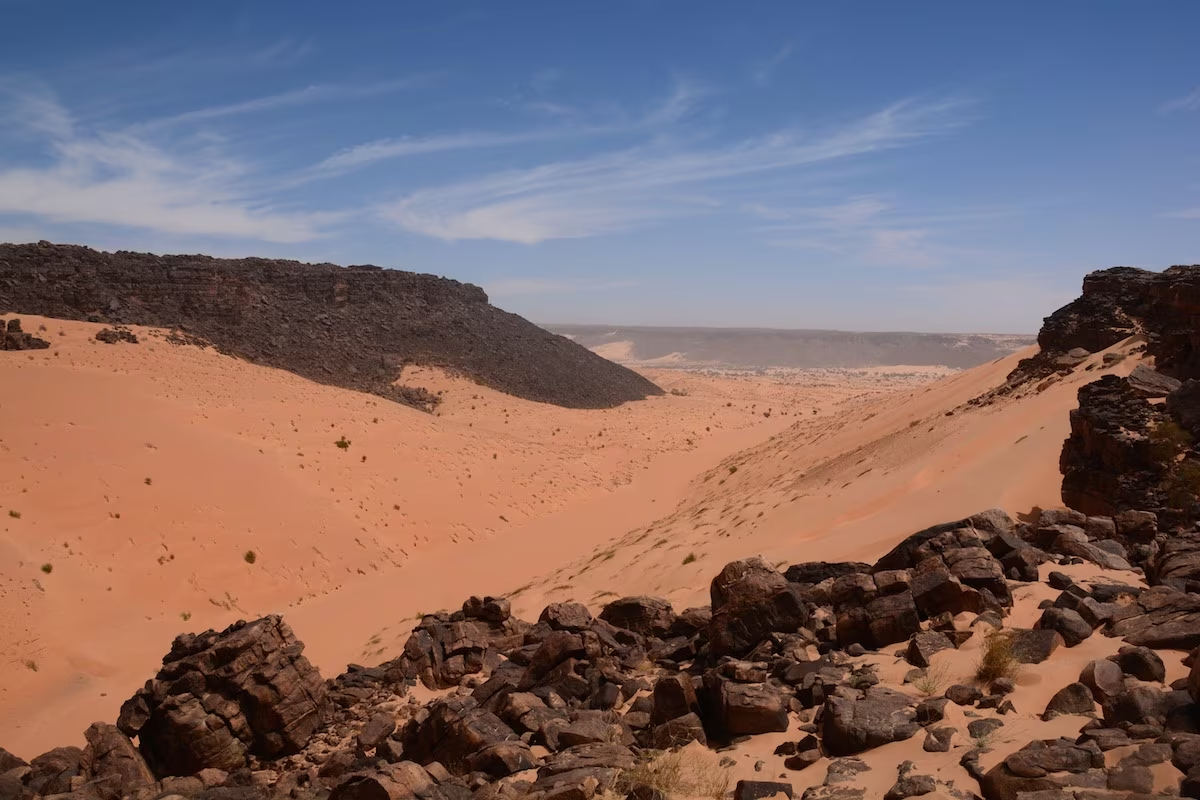
Off the beaten path, this highly varied hike oscillates between the blonde granites of Taessa and the traditional landscapes of the heart of Hoggar: plateaus and volcanic peaks, valleys and granite mountains, lush wadi beds where refreshing gueltas (water pockets) persist.
Then we migrate north, towards Algiers the White.
Algiers the White is the nickname given to the capital of Algérie, because of the color of its facades that contrast with the blue of the Mediterranean Sea. Algiers is a city steeped in history, which has experienced several cultural influences, namely Berber, Arab, Ottoman, French and Spanish. Algiers is also a modern city, which houses political, economic, cultural and university institutions.
Algiers the White offers its visitors remarkable architectural and natural heritage, including the Casbah, listed as UNESCO world heritage, the Basilica of Notre-Dame d'Afrique, the Hamma botanical garden or the Bardo national museum.
We invite you to discover Algiers, this fascinating city that captivates through its charm and diversity.
A wonderful adventure to experience.
The stages of your journey
Highlights
Day-by-day itinerary

France > Algiers > Tamanrasset
Upon arrival in Algiers, welcome and airport assistance.
Depending on arrival time, departure for a short visit of central Algiers.
After a snack, return to the airport to board the domestic flight to Tamanrasset.
Upon arrival in Tamanrasset, you will be welcomed by the team and transferred to the hotel Le Caravansérail.

In a 4X4 vehicle, the volcanic basin of Wadi Tanget
Early in the morning, we leave Tamanrasset by the paved road that bypasses the Hoggar massif to the south. We quickly leave the road heading towards In Guezam and Niger to head east. The Adriane mountain, which marks its presence on the city of Tamanrasset, is now behind us. We drive through a landscape formed by granite boulders, characteristic of the geological belt that surrounds the volcanic region of Atakor.
We reach the Tuareg village of Tahifet and leave the paved road to venture due north into the heart of the Atakor. Lava peaks begin to shape our landscape and we climb a canyon that can be narrow in places. A surprise—water emerges and the river flows amid gorse, surreal amid this austerity.
A cluster of palm trees awaits us for our midday stop. It is an idyllic spot with crystal-clear water flowing at our feet. However, this place has become—quite rightly—a weekend outing for people from Tamanrasset. Unfortunately, the site can be soiled and our daily battle is to raise awareness among people about respecting this fragile environment.
We continue our 4x4 track to reach the heart of the Tanget wadi. This vast amphitheater is composed of volcanic peaks bristling in an immense grandiose chaos: Oussouk (1626 m), Tarara (1860 m), Ekneouen (The Twins), Tetaqaout, Tin Sanen… We pass through the heart of a volcanic chimney and set up our bivouac in this stunning place.
For history's sake, the Tan n'Manri corridor is the defile where the Kel Ajjer defeated the Kel Ahaggar (around 1875), despite being ambushed on the slopes overlooking the track. Several tombs remind the traveler of this battle famous among the Tuaregs.
Rock carvings are present, witnesses to a much more favorable past for pastoralism. We take advantage of late afternoon to take a walk and, why not, admire our first Saharan sunset from a high vantage point.

From Tangier to the gardens of Ezernene then the Assekrem trail
After enjoying this singular place, we resume the track in the direction of Tahifet, which allows us to exit the Oued Tanget basin. We quickly abandon this track to turn west. We leave behind us the immense volcanic neck of Aguelzam, which, like others in this area, is a remnant of past volcanic activity and contributes to the unique and impressive beauty of Hoggar.
A neck is a residual volcanic landform, often cylindrical or conical in shape, like a butte, a peak or a needle. It is the conduit of an ancient volcanic chimney that solidified at the end of an eruption and was subsequently exposed by erosion. These formations can vary in size, ranging from a few tens to several hundred meters in diameter. Often, we can observe very beautiful basalt columns.
Gradually, we gain altitude to reach the gardens of Ezarnene, located in a depression where the wadis from the southern part of the Atakor massif flow. The horizon is dotted with volcanic peaks, some of which are very well-known in Saharan literature, such as Daouda and Akar-Akar.
We reach the track coming from Tamanrasset and running on the high plateaus of the Hoggar. At midday, we arrive at the Afilal gueltas. Water flows through a basalt fissure, offering a beautiful place to have our lunch in the shade of an acacia tree. The Afilal gueltas are permanent watercourses in a totally desert environment, rich in vegetation and wildlife, notably the desert barbel.
We resume the trail, which is very damaged at the moment due to heavy summer rains in 2024. We are now driving between the most beautiful peaks of the Atakor: Tezouiag (the Bustards, 2702 m), Asaouinan (2637 m), Oul (the Heart, 2602 m), Taridalt (the Hyena, 2422 m).
We access by car the pass located below the plateau of Assekrem. On foot, we climb the hundred meters and what a reward when we arrive at the Hermitage of Father de Foucauld! Often, a cold wind blows over the heights. The hermitage, built in 1910, offers a spectacular view over the Hoggar mountain range and today serves as a meteorological station.
After visiting the Little Brothers of Jesus, guardians of the Hermitage of Father de Foucauld, and witnessing the sunset over the mythical mountains of the Atakor, we rejoin our camp. It is at this moment that we leave the vehicles, which will return to Tamanrasset. We meet up with the camel caravan which will accompany us over the coming days.

Assekrem > Imezeroug > Tin Eguefes
After loading the camels, we begin our hiking in the Atakor mountains. The caravan can take different routes than ours to avoid difficult passages for loaded animals.
We head towards a magnificent mountain named Imezeroug. We venture into the Imezeroug mountain to discover some fascinating rock paintings. This site is very curious, as the mountain contains a vast cirque where vegetation grows composed of olive trees, lavender and Artemisia herba-alba.
The Hoggar olive, also known as Laperrine's olive (Olea europaea subsp. laperrinei), is a species of olive tree endemic to the Hoggar massif. This tree is particularly remarkable for its ability to survive in extremely arid and hostile conditions.
Laperrine's olive is found mainly in the beds of wadis. Close to the European olive, it is however adapted to the desert conditions of the Sahara. It is threatened with extinction due to habitat degradation and climate change.
These olive trees play a crucial role in the local ecosystem, providing shade and habitat for various animal and plant species. Their presence testifies to the resilience of Saharan flora and the importance of conserving endemic species in extreme environments.
We continue our hike to reach in mid-afternoon our camp site in the Tin Eguefes wadi or in the Ihasseyen wadi.
A few words about the fauna of the Hoggar
The large animals, such as the gazelle and the bighorn sheep, tend to disappear due to hunting, although the bighorn sheep resists better by hiding in the mountains. The carnivores, such as the jackal, the fennec fox, the fennec and the wildcat, are still present. The cheetah, meanwhile, is becoming very rare.
The rodents remain numerous, including jerboas, gerbils, meriones, gundis, as well as various species of rats and mice. Rock hyraxes, belonging to the family of procaviids, live in small colonies in the rocks near the wadis, where they find their food, notably acacia leaves.
The family of lagomorphs is represented by the Cape hare.

Tin Eguefes > Taessa > Ilaman
We walk across the stunning granite massif of the Taessa, where several routes are possible. This massif is characterized by its impressive rock formations and its breathtaking landscapes.
We find the caravan in the Ilaman wadi for the midday stop. This wadi offers a striking contrast with the surrounding aridity. We follow the sunken course of the wadi to the bivouac, crossing small centers of life where the Tuareg Kel Ahaggar cultivate gardens and raise livestock.
The Tuareg, known for their semi-nomadic way of life and their rich culture, have been the guardians of these lands for centuries. Their in-depth knowledge of the terrain and local plants, used for medicinal and food purposes, is invaluable. At the end of the day, we set up our bivouac under a starry sky, ready to explore further this fascinating landscape tomorrow.
The legend of the Tuareg Kel Ahaggar
Several elements of oral history and popular legends, notably about the origin of the tribes, confirm this. The Kel Rela, the last reigning family, claim to descend from a Berber queen who came from Tafilalet with her servant. Their tombs are located near Abalessa, 80 km northwest of Tamanrasset.
Tin Hînan, this queen, nearly died of hunger before reaching the Ahaggar and settled peacefully in this region which she found almost deserted. A few pagans, the Isebeten (or Issebetènes), inhabited the Taessa massif, the most inaccessible part of the Atakor. Tin Hînan is said to have given rise to the Kel Rela, while her servant Takama would be the ancestress of three important tribes: the Dag Rali, the Aït Loaien and the Kel Ahnet.
Whatever the veracity of this legend, oral tradition mentions the existence of the Issebetènes, very primitive and pagan people, not very combative, few in number and completely isolated. Some individuals among the Dag Rali still discreetly claim today to descend from the Issebetènes.
We find historical connections with the Almoravid epic where the grouping of tribal groups allowed them to enter Spain. In this ensemble, a small tribe established not far from Sijilmasa, in Tafilalet, was named the Targat. We are therefore in the twelfth century. When the Almohads of the Rif gained ascendancy over the Almoravids, this small group departed towards the southeast, into the desert, led by a queen.

Ilaman > Essouf Mellen
We leave the Ilaman wadi to cross a basalt plateau, from which we can see, to the east, the village of Terhenanet, belonging to the Dag Rali tribe. This village is located in the wadi of the same name, which we descend into. Along the way, we admire the spectacular rock formations.
We follow the Terhenanet wadi, whose bed is occupied by a curious flow of black or blue basalt winding through the hills. This basalt flow, formed by ancient volcanic eruptions, creates a striking contrast with the surrounding landscape. Abundant vegetation, composed of oleanders and tamarisks, grows there, offering touches of greenery in this arid setting. The oleanders, with their bright pink-red flowers, add a note of vivid colour, while the tamarisks provide shade and coolness.
In the afternoon, a steep and delicate track leads us to the deep guelta of In Outer, surrounded by reeds. This guelta, a rare source of permanent water in the desert, is a true oasis of life. The reeds surrounding it harbour a varied fauna, notably birds and small mammals, attracted by this precious water resource.
We set up our bivouac at Essouf Mellen, also known as "the white solitude". This place, with its vast white expanses and imposing rock formations, offers a peaceful and isolated setting for spending the night.

Essouf Mellen > Tissalatin Tin Tagmart > Tamanrasset
Essouf Mellen → Tissalatin Tin Tagmart
We continue heading south through the Taessa massif, surrounded by numerous granite domes. The walk is easy and the horizons are clear, offering breathtaking panoramic views. The valley floors are carpeted with superb acacia forests, whose branches provide welcome shade and shelter a variety of birds and insects.
At midday, we reach the Tissalatin Tin Tagmart region. We have lunch in this idyllic setting, surrounded by impressive rock formations.
Tissalatin Tin Tagmart → Tamanrasset
Our vehicles join us in the early afternoon. After saying goodbye to our travel companions, we head towards Tamanrasset.
We leave behind the majestic massifs of Taessa and Atakor, as well as our camel team with whom we shared these few days outside of time. These moments spent together, in the heart of grandiose landscapes and under a starry sky, will undoubtedly remain engraved in your memories.
Tamanrasset (located at 1400 m) has become an imposing city in just a few years. Only the town centre, with its streets shaded by tamarisks, has retained its original charm. We dine at the Caravansérail hotel. A room will be made available to you to drop off your luggage, rest and take a shower before the night transfer to the airport. Hotel departure approximately 23:30.

Flight Tamanrasset > Algiers
Airport reception and transfer to the hotel.
We have lunch in a typical restaurant (at your own expense).
Departure late in the morning for the Hamma Test Garden (botanical garden). Created in 1832, with the aim of reclaiming a marshy terrain in order to transform it into agricultural land, this garden becomes a "Central Government Nursery", which initially extends over 5 hectares and then expands to 18 hectares in 1837. Subsequently, it becomes an "Acclimatization Garden" and then a "Pleasure Garden" with the development of horticulture; the goal being to introduce various plant species in order to test their acclimatization and adaptability to the local climate. At the northern end of the dragon tree alley is the zoological garden which brings together specimens of North African fauna and some wild animals.
The El-Hamma Test Garden served as a natural setting for the filming, in 1932, of Tarzan, the ape man by American filmmaker Woodbridge Strong Van Dyke. The character of this jungle lord was portrayed on screen, in this feature film, by Johnny Weissmüller, an American actor of Austro-Hungarian origin. Tarzan, a fictional character known throughout the world, has inspired several writers, filmmakers and comic book creators. One only needs to close their eyes to imagine, emanating from a giant ficus, the very first cry of Tarzan.
At the end of the day, let's take time to stroll along the waterfront. You can dine in one of the many restaurants in the city center.

Visit to the Casbah of Algiers and the downtown area
We invite you today to stroll through the narrow streets of the casbah.
The Casbah of Algiers, also known as El Qasbah, is an emblematic historic district that embodies the soul of the Algerian capital. Founded in the 10th century by Bologhine Ibn Ziri on the remains of the ancient Roman city of Icosium, the Casbah is a masterpiece of Islamic architecture and a fascinating example of Arab-Berber medina urbanism.
Throughout its history, the Casbah reached its peak during the Regency of Algiers, a period when it became the heart of political and economic power for the Ottoman deys. Its narrow and winding streets, lined with white multi-story houses, contain many majestic palaces and historic mosques, testifying to the richness of its heritage. The citadel, perched above the Casbah, offers a spectacular panoramic view of the Bay of Algiers and the Mediterranean Sea, adding to the beauty of this exceptional site.
The history of the Casbah is marked by foreign interventions, from Romans to Turks, passing through the French. It played a crucial role during the Algerian War, becoming a stronghold for FLN independence fighters. Although it lost its central role after independence in 1962, the Casbah remains a powerful symbol of Algerian culture and history.
Surrounded by legends and mysteries, the Casbah is renowned for its labyrinthine streets, designed to confound invaders and protect its inhabitants. It is also the birthplace of many artistic and craft traditions, notably chaâbi music, which continues to resonate through its bustling streets.
Today, despite challenges related to preserving its heritage, the Casbah of Algiers continues to inspire artists and writers, and remains a place of memory and pride for Algerians. We invite you to lose yourself in its streets, to climb its stairs, to explore its shops and to admire its viewpoints to savor this historic, living and vibrant wonder. The Casbah is much more than just a neighborhood; it is a true journey through time and Algerian identity.
We have lunch in a typical restaurant.
We continue our visit in the afternoon across the Place of Martyrs. Visit of the Palace of Raïs "Bastion 23" - Cultural Arts Center – the only remaining witness to the extension of the Casbah to the sea. Next, we will head to higher ground (transfer by vehicle) to visit « The Basilica of Notre Dame d'Afrique ». If the weather is nice, we will probably be able to enjoy a beautiful sunset.
Return to your hotel. Free dinner.

Price per person
This trip can be tailored to your preferences
This itinerary provides an excellent foundation for discovery, but it can be fully customized. Our local advisors build each trip tailored to your budget, dates and preferences.
Not included
- Visa fees obtained upon your arrival in Algérie
- Flights to Tamanrasset
- Insurance "Cancellation", "Repatriation" and "Travel Risks"
- Your personal expenses: all beverages during meals at the restaurant and inn (including water), phone calls, tips, etc
- All costs incurred by a possible extended stay beyond our control outside the planned program
Included
- Assistance and transfer between the airport and accommodation in Tamanrasset
- Caravanserai in Tamanrasset on a double room basis with breakfast
- Hotel El Djazaïr (former Saint Georges) in Algiers on a double room basis with breakfast
- Transportation to reach the hiking departure point and for the return to Tamanrasset
- Tuareg camel team with camels for carrying luggage and supplies
- All camping equipment during the hike except your sleeping bag
- All meals at bivouac: from lunch on D2 to lunch on D7
Practical Information
Registration is considered firm and final after payment of a deposit of 30% of the total price and acceptance of the specific terms of sale.
The balance must be paid no later than 45 days before the departure date.
See our specific terms of sale for full details.
In the event of cancellation by the traveller, the following fees apply:
- Plus de 60 jours avant le départ : 40 % du prix total (acompte retenu)
- Entre 60 et 30 jours avant le départ : 50 % du prix total
- Moins de 30 jours avant le départ : 100 % du prix total
We strongly recommend taking out cancellation insurance. See our specific terms of sale for full details.
The information below concerns travelers who are nationals of the European Economic Area (EEA), Switzerland, and Canada traveling to Algeria for a tourist stay. As entry rules may change, we recommend verifying this information with the official authorities before your departure.
Passport
To enter Algeria, your passport must be valid for at least six months after your date of entry into the country and have at least one blank page for immigration stamps.
The document must be in good condition (no damaged, torn, or altered pages).
Visa
Nationals of the European Economic Area, Switzerland, and Canada must be in possession of a valid visa to enter Algeria for a tourist stay. There is no visa exemption for these nationalities.
The visa must be obtained before departure, from the Algerian embassy or consulate responsible for your country of residence. It is recommended to apply several weeks in advance, as processing times may vary.
Documents generally required for a visa application include:
a valid passport with at least six months of remaining validity,
a completed and signed visa application form,
recent passport-sized photos complying with required standards,
a return flight ticket or booking,
proof of accommodation (hotel reservation or invitation),
proof of sufficient financial resources for the duration of your stay.
The authorized length of stay is generally 30 days, depending on the conditions mentioned on the visa issued.
Travel with children
Minors must be holders of their own valid passport covering the duration of their stay.
In some European countries, when a minor travels without one of their parents, an authorization to exit the territory may be required according to the regulations of their country of residence.
Health
No vaccination is officially required to enter Algeria for nationals of the EEA, Switzerland, and Canada. However, it is recommended to consult a doctor or vaccination center before departure and to ensure that basic vaccinations are up to date (diphtheria, tetanus, poliomyelitis, hepatitis A).
It is also advisable to take out international health insurance covering medical expenses and repatriation for the entire duration of your stay.
Other nationalities
Entry conditions may vary depending on nationality. Travelers concerned should inquire at the Algerian embassy or consulate of their country of residence.
To participate in our trips, it is strongly advised to have assistance-repatriation and foreign medical expenses insurance.
Your local agency encourages you to familiarize yourself with the specific policy developed with our partner CHAPKA ASSURANCES and AXA ASSISTANCE.
To subscribe to insurance, learn about coverage and rates, follow the link below.
CAP EXPLORER: The complete insurance solution designed for a worry-free trip!
Choose the plan that best suits you:
Explorer'Multirisque
Explorer'Annulation
Explorer'Assistance
Explorer' Complementary Credit Card
Specific to our trips, we strongly recommend subscribing to them.
If you choose to subscribe to one of these plans, the policy detailing all coverage and claims declaration procedures are available on the insurer's website.
Your local agency will be aware of this, but only the participant is responsible for complying with the claims declaration procedures. The participant must therefore keep this policy with them throughout their trip.
Chapka — Cap Explorer
Our insurance partnerTravel with peace of mind with our partner Chapka. Cancellation, repatriation, medical expenses, baggage… All the coverage for a worry-free trip.
Travel with peace of mind — I'll handle the insuranceFrequently asked questions
A tourist visa is required and must be requested from the consulate (consular fees apply, processing time 2-3 weeks). An invitation letter or accommodation certificate is required. Your passport must be valid for at least 6 months beyond your planned entry date. Conditions can be stringent. We strongly recommend verifying the rules applicable to your nationality with the Algerian consular authorities before booking your trip.
Go to the My Trips section to find all your projects.
You can send a message to your host directly from the Tea Lounge.
For a tailor-made quality trip, budget between 140 and 240 euros per day and per person, including accommodation, meals, internal transfers and English-speaking guide. International flights (350-700 euros return) are additional. The Algerian Sahara (Tassili, Hoggar) requires a specific budget.
Your documents are accessible in the Documents tab of your trip.
Absolutely. We adapt each itinerary to match your travel profile. For families, we prioritize relaxed paces, family-friendly accommodations, engaging and educational activities, and comfortable private transfers. Our local English-speaking guides know how to captivate children with age-appropriate stories and anecdotes.
It's simple. You exchange with our local team to define your wishes, budget and dates. You receive a detailed itinerary proposal within 48 hours. You refine every detail together until you have the perfect version. You confirm and set off with peace of mind. Your local agency remains available 7 days a week throughout your trip.
In case of emergency, contact your local agency immediately.
Payment is generally made in two installments.
Our agency is part of the Nomadays network, registered in France. You benefit from APST guarantee (Professional Association of Tourism Solidarity) which covers 100% of your funds. Secure payment, repatriation insurance included, and English-speaking assistance 24/7 on site throughout your stay.

Let's talk about your adventure — Great Saharan South
Pioneer of Algeria's great deserts, based in Ghardaïa / M'zab (puis Alger à partir de 2006)
The desert is not crossed with an itinerary alone. It demands listening, respect, and a certain inner availability.
— Louiza