The Amadror Salt Marshes
The Amadror Salt Marshes
Ancient caravan salt marshes of the Hoggar, 350 km from Tamanrasset: Tuareg history, Saharan landscapes and 4x4 access.
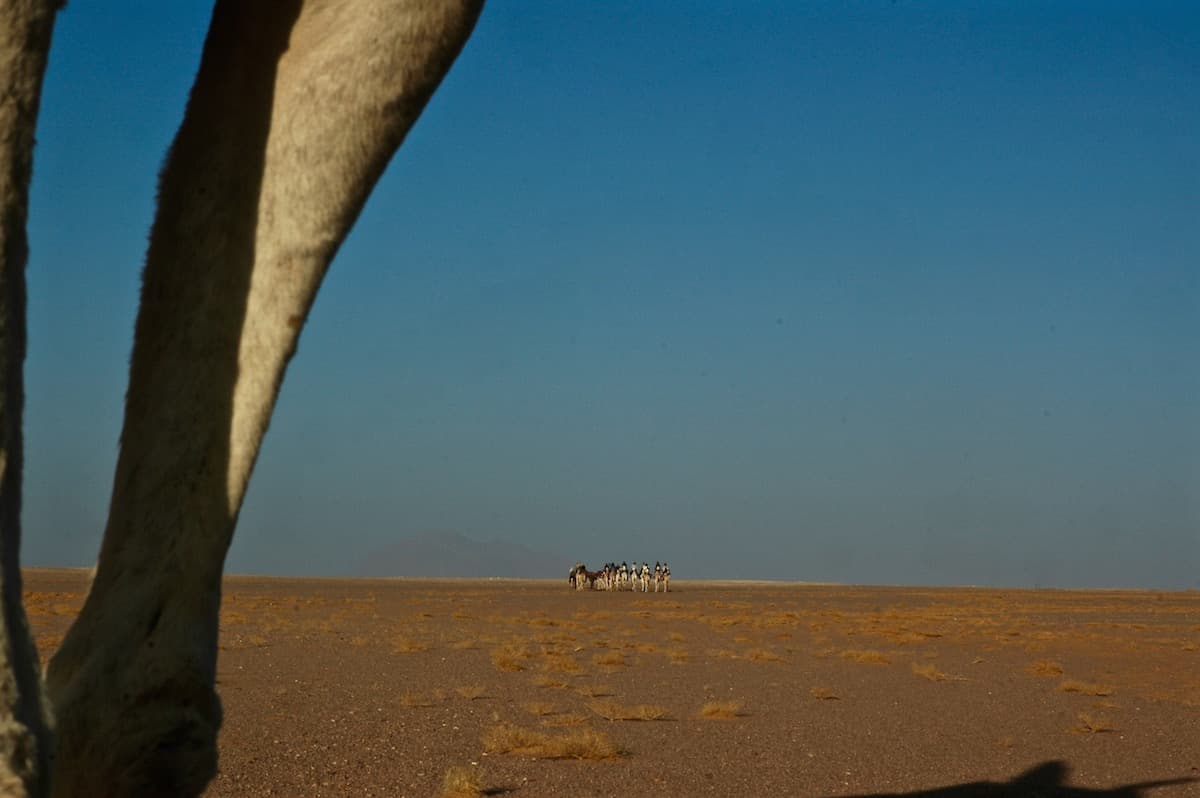
The Amadror Salt Marshes occupy a vast depression in the northeast of the Hoggar massif, approximately 350 km northeast of Tamanrasset. In the 20th century, this site was one of the pillars of Tuareg caravan trade: salt was extracted in the open air and then transported by camel toward Niger. Today little frequented, Amadror must be earned: it takes at least two days of 4x4 track driving to reach these white expanses ringed by basaltic plateaus and volcanic mountains.
Why visit the Amadror Salt Marshes
The site's appeal is as much ethnographic as it is scenic. You traverse a territory where the memory of great trans-Saharan caravans remains alive: the Tuaregs of Aït Loaïen and Kel Ajjer continue to extract salt there for personal use, perpetuating a practice thousands of years old. The visual contrast is striking: white salt expanses, ochre earth, the dark ridges of nearby Hoggar. It is also rare terrain in Algérie to understand Saharan trade routes beyond the major rock art sites.
History of the salt marshes and caravan commerce
Exploitation of salt at Amadror dates back to the age of great trans-Saharan caravans. Between 1900 and 1970, the salt marshes held an important place in the Hoggar economy. Salt was extracted in the open air, cut into blocks of 40 to 60 kg, then loaded onto camels. The trail descended toward Niger, where salt was exchanged for millet—the dietary staple of Sahel populations.
One feature distinguished Amadror: its salt was prized for human consumption by Niger populations, while that from Bilma, in Niger, was rather intended for livestock. This reputation, which stemmed as much from mineral quality as from cultural perception, explained the high exchange value of blocks from the Hoggar.
The opening of paved roads and the mechanization of transport gradually marginalized these caravans. They now belong to the past, but a few Tuareg families maintain a direct link with the site.
What to see on site
The Amadror wadi basin extends over approximately 180,000 km² according to geographic sources, making it one of the largest endorheic depressions of central Sahara. On site, several elements warrant attention:
- Salt crusts: white cracked expanses where historical extraction zones can still be distinguished.
- Hewn blocks: traces of cutting and abandoned fragments can be found in places.
- Surrounding geology: basaltic plateaus, wind-eroded formations, testimony to ancient volcanism.
- Halophytic flora: rare vegetation, adapted to saline soils and aridity.
- Silence and isolation, characteristic of little-visited Saharan depressions.
How to get there
The logical starting point is Tamanrasset, accessible by air from Algiers. From Tamanrasset, plan for a minimum of two days of 4x4 track driving to reach the salt marshes, following the route that skirts the Téfédest massif. The salt marshes are located east of Garet El Djenoun (a 2,230 m mountain in the Téfédest massif), southwest of the Tihodaïne erg and northeast of Aréchoum.
No public transport serves the site. Access is mandatory with a 4x4 vehicle and an experienced driver-guide, as part of an organized tour.
Practical information
- Recommended duration: plan a tour of 5 to 8 days minimum to integrate Amadror into a coherent Saharan circuit.
- Logistics: bivouac travel, water and fuel to transport, no infrastructure on site.
- Guidance: Tuareg guide familiar with the terrain is essential, both for safety and for reading the site.
- Permits: the Hoggar zone requires administrative permits; the partner agency handles this.
- Equipment: warm clothing for desert nights, sun protection, closed-toe shoes.
When to go
The best period runs from October to March. Daytime temperatures remain tolerable (often between 15 and 25 °C) and nights are cool to cold. From April onward, heat makes track travel exhausting, and summer is to be avoided. December to February offers the most stable conditions for bivouacking and photography.
To see in the region
An expedition to Amadror logically combines with other sites in southern Algérie:
- The Hoggar National Park, which encompasses the volcanic landscapes around Tamanrasset.
- The Tassili n'Ajjer National Park, famous for its rock paintings.
- Tin Merzouga, in the Tadrart rouge, for its dunes and sandstone formations.
- The Saharan fauna, observable during long crossings.
Frequently asked questions
Frequently asked questions
Preparing your trip
The Amadror Salt Marshes are for travelers ready to spend several days bivouacking in a little-visited Sahara. To integrate this site into a bespoke itinerary, consult our tours in Algérie.
Interested in this visit?
We can include it in your personalised itinerary.