Moul N'Aga
Moul N'Aga
A dune cirque of the Red Tadrart, Moul N'Aga combines sandstone arches, rock paintings and bivouacking in Tassili n'Ajjer, departing from Djanet.
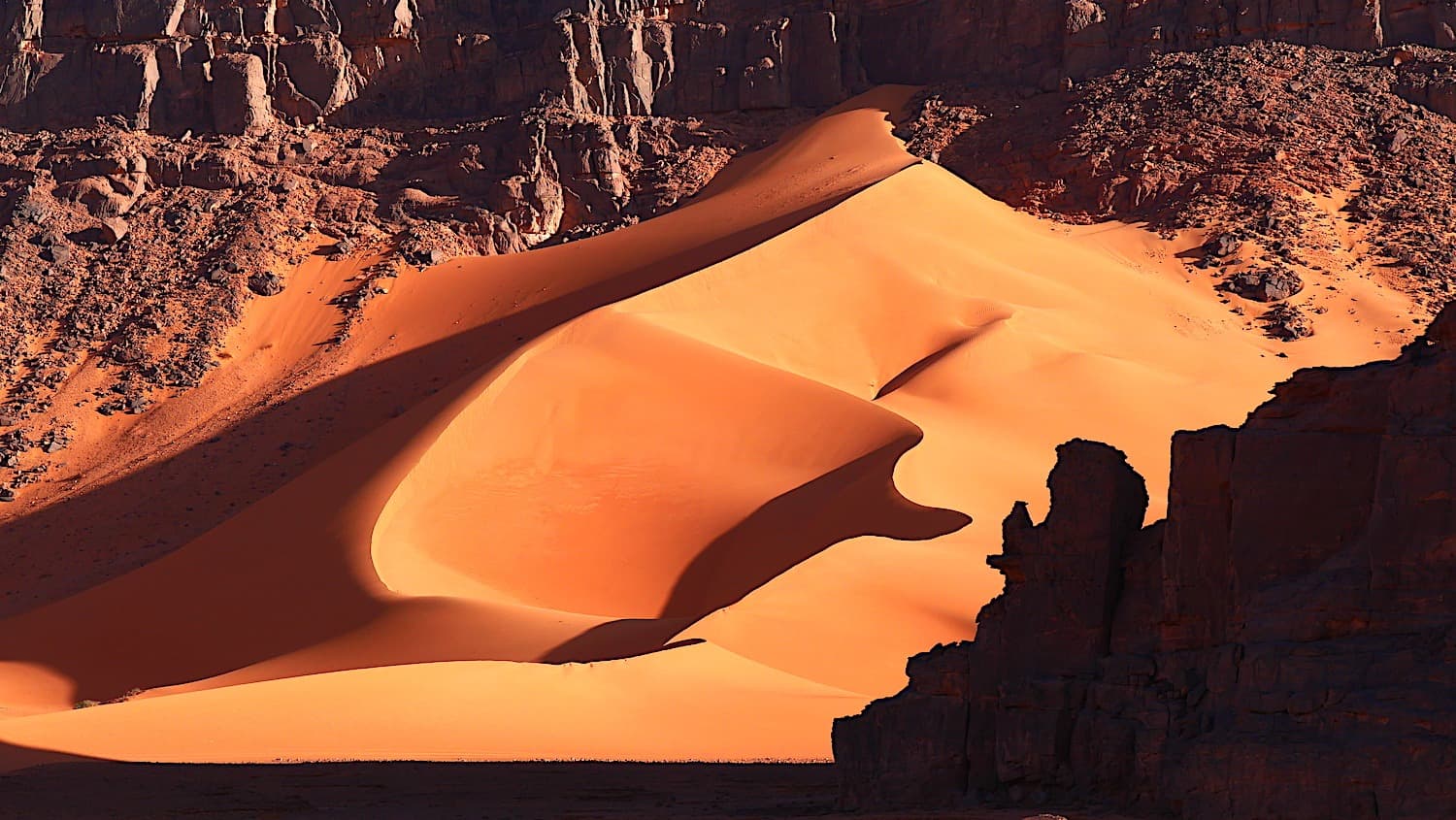
Moul N'Aga is a dune cirque located in the Red Tadrart, southeast of the Tassili n'Ajjer National Park. The site takes its name from a sandstone fortress whose silhouette evokes that of an n'aga (camel in Tamasheq). It combines vast dunes of orange sand, sandstone arches and rock art, in one of the most remote areas of the Algerian Sahara.
Why visit Moul N'Aga
Moul N'Aga concentrates, within a restricted perimeter, several emblematic features of the Tadrart: a cirque of orange dunes, monumental sandstone arches of which the most famous is nicknamed the "cathedral of Tamezguida", and rock paintings attributed mainly to the Bovine period (approximately 7,000 to 4,000 years ago). The site is renowned for its late afternoon light, ideal for bivouacking on location.
Unlike more accessible Saharan dunes, Moul N'Aga is worth the effort: it is accessible only by 4x4, as part of organized circuits departing from Djanet. This logistics naturally limits visitor numbers.
What to see on site
The camel-shaped sandstone fortress
A characteristic rock formation of the site, this camel-shaped sandstone fortress (N'Aga) serves as a visual landmark and gives the place its name. A short walk around the massif allows you to appreciate it from different perspectives.
The Cathedral of Tamezguida and the arches
Before reaching the dune cirque, the route crosses several sandstone arches. The most imposing, nicknamed the "Cathedral of Tamezguida", forms a natural vault spanning dozens of meters. The surrounding walls preserve legible rock painting panels.
The dune cirque
The heart of the site is an amphitheater of orange dunes, ideal for a one to two-hour hike and a secluded bivouac. The panorama from the top of the dunes covers the entire surrounding plateau.
Other sites in the Red Tadrart
Moul N'Aga is part of a larger circuit through the Red Tadrart. Typical stages include:
- El Berj: wide sandstone canyons adorned with rock paintings and engravings.
- In Tehak: dunes with changing colors, arches and rock art.
- In Djaren: the largest wadi in the Tadrart, with over 15,000 documented rock paintings and engravings.
- Tin Merzouga: one of the highest dunes in the Sahara, reaching approximately 1,300 meters elevation.
- Tagharghart: site of the engravings of the "weeping cow", dated over 7,000 years ago.
- Tissetteka: area home to the Tin Abadène canyon.
Other regions of southern Algérie complement this type of itinerary, notably Assekrem in the Hoggar or the Garet El Djenoun massif.
When to go
The best period runs from October to March, with daytime temperatures ranging between 20 and 25 °C and cool nights, sometimes near freezing in the depths of winter. Conversely, the months of June to August are not recommended: temperatures can approach 45 °C during the day and make exploration exhausting. April, May and September are intermediate periods, still practicable but already warm.
How to get there
The starting point is Djanet, capital of Tassili n'Ajjer, connected to Algiers by domestic flight (from Europe, the route generally goes through a connection in Algiers). From Djanet, access to Moul N'Aga is exclusively by all-terrain vehicle, accompanied by a local guide approved by the national park.
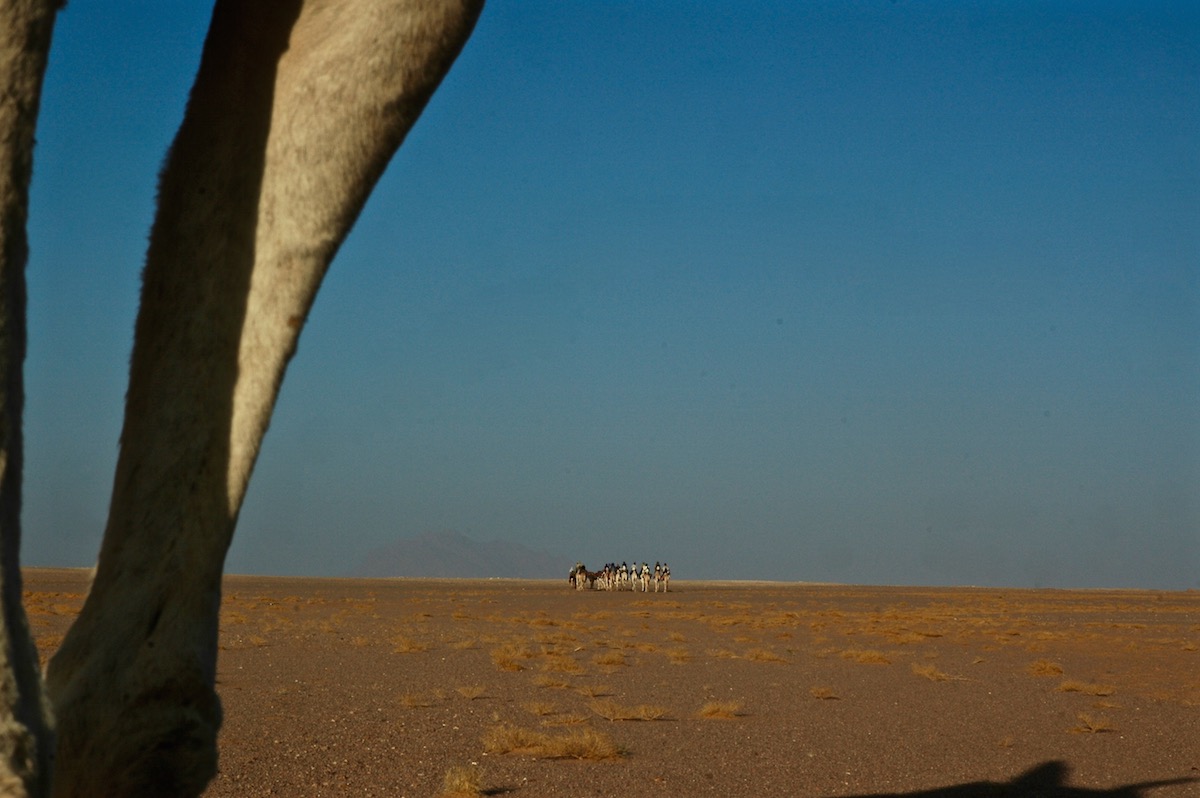
Circuits in the Red Tadrart typically last 7 to 10 days, with the 9-day format being frequently offered. They combine stages of driving and successive bivouacs under tent or under the open sky.
Practical information
- Guidance: visits only on organized circuits with guide and driver approved by the Tassili n'Ajjer National Park.
- Authorizations: a border zone access permit is required, managed by the local agency.
- Bivouacking: allowed on established sites, with responsibility to leave no trace.
- Equipment: warm sleeping bag (cold nights in winter), turban, sunglasses, sunscreen, headlamp.
- Connectivity: no mobile network on site, plan for complete disconnection.
Frequently asked questions
Frequently asked questions
To include Moul N'Aga in a broader itinerary across the Algerian Sahara, consult our journeys in Algérie.
Interested in this visit?
We can include it in your personalised itinerary.