ANCIENT ALGERIA AND GATES OF THE SAHARA — From Tipaza to Timimoun, forty centuries between Mediterranean and great dunes
From the Roman amphitheatres of Timgad to the ochre dunes of Timimoun, forty centuries of Algerian history.
Duration
17 days
From
€2,870/pers.
Ideal seasons
Feb, Mar, Apr, Oct, Nov, Dec
Style
Guided tour
Comfort
classique
Travelers
Couple, Solo, With friends, senior, groupe
The spirit of travel
This journey takes you from one coast to another of ancient Algérie to lead you to the very gates of the Sahara. It is a great transect from north to south that is proposed to you, on an axis Oran — Alger — Constantine — Aurès — M'Zab — Erg Occidental, which condenses in seventeen days the essential landscapes, civilizations and architectures that make Algérie a truly continental country.
We begin in Oran the radiant, a city of four cultures where Andalusian, Ottoman, Spanish and French heritages intersect, then we travel along the Mediterranean coast to Cherchell, the ancient Caesarea of King Juba II, and Tipaza, a jewel listed by UNESCO. Alger the White welcomes us next: its Casbah, its Botanical Garden, its Basilica of Notre-Dame d'Afrique, its Museum of Fine Arts.
The journey then heads East and shifts into Roman Algérie. Djemila, the ancient Cuicul perched at 900 meters, then Constantine, the City of Suspended Bridges hanging above the gorges of the Rhumel, and finally Timgad — the African Pompeii founded by Trajan in the year 100. We then descend towards the Aurès, land of the Chaouias, through the Balconies of Ghoufi and the gorges of El Kantara, the "mouth of the Sahara" through which the great shift towards the South takes place.
Beyond Biskra and Bou Saâda — the city of painter Étienne Dinet — opens the true second part of the journey: that of oases and sands. Ghardaïa and the pentapolis of M'Zab reveal to us the urban and hydraulic genius of Ibadite Berbers, then we cross the Erg Occidental to El Goléa, where Father Charles de Foucauld rests, and finally Timimoun the Red, capital of Gourara, nestled between ochre dunes and palm groves.
From the Mediterranean to the confines of the Great Erg Occidental, this journey is a crossing of rare magnitude: forty centuries of history, four climates, from Numidian cities to Mozabite ksour, from Roman amphitheaters to thousand-year-old foggaras. It is a true initiation to the depth and diversity of Algérie.
Important: This exceptional journey is also available in 13 days. It completes its progression in Ghardaïa, in the Mzab valley.
The stages of your journey
Highlights
Day-by-day itinerary

FLIGHT EUROPE → ORAN: ARRIVAL IN RADIANT ORAN
Arrival at Ahmed Ben Bella Airport in Oran. Our team welcomes you at the plane exit and accompanies you through immigration formalities and baggage collection, before transfer to the city center.
First contact with Oran the radiant, Algeria's second city, a Mediterranean port with an indefinable charm where Andalusian, Spanish, Ottoman and French heritages have intersected for centuries. Depending on arrival times, a stroll along the seafront and discovery of November 1st Square — the famous "Place d'Armes" with its town hall featuring two bronze lions, the Abdelkader Alloula regional theater, the Sacré-Cœur Cathedral (now the municipal library).
Welcome dinner in a typical restaurant in downtown Oran. Night at the hotel.

ORAN: SANTA CRUZ, SIDI EL HOUARI AND THE SPANISH QUARTER
Full day dedicated to discovering Oran. In the morning, climb to Mount Murdjadjo overlooking the bay: visit to the fort of Santa Cruz and its chapel, remnants of the long Spanish presence (16th-18th centuries), with a stunning panorama over the city and the Mediterranean. Descent towards the historic district of Sidi El Houari, Oran's oldest quarter, where we visit the palace of Bey Mohamed El Kebir (18th century), a magnificent example of beylik architecture, and the Pasha Mosque (1796), built during the reign of Baba Hassan, dey of Algérie.
Traditional lunch at the Pêcherie, in the lively atmosphere of fish restaurants along the waterfront.
In the afternoon, we visit the Ahmed Zabana museum, the city's main museum (archaeology, ethnography, fine arts), then we discover the neo-Moorish railway station of Karguentah, a work by architect Albert Ballu — a jewel that harmoniously blends neo-Moorish and art nouveau styles. Stroll through the boulevards of colonial Oran, past the arenas (unique in Algérie) and the Italian-style theatre.
At the end of the day, wandering through the medina of Oran, Algérie's oldest casbah.

ORAN → CHERCHELL → TIPAZA: ON THE ROAD TO ANCIENT ALGERIA
Early morning departure heading east along the Mediterranean coast. We leave Oran and its wine-growing hinterland to reach the Algiers coastline. Our first major ancient stop is Cherchell, the former Caesarea of Mauretania: capital of the kingdom of Juba II and Cleopatra Selene (daughter of Cleopatra VII and Mark Antony), at the turn of our era, Cherchell became one of the brightest cultural centers of the Berber-Roman world.
Visit to the Cherchell archaeological museum, renowned for its exceptional collection of ancient sculptures — a veritable anthology of African Greco-Roman art. Discovery of the remains of the thermal baths and the aqueduct that supplied the city from Atlas springs.
Lunch in Cherchell.
In the afternoon, we continue to Tipaza, a former Phoenician city that became a Roman colony, listed as a UNESCO World Heritage Site. In an exceptional Mediterranean setting — the remains descend gently down to the sea — we discover the forum, the theatre, the Christian basilica, the House of Frescoes, all in an atmosphere that already evoked for Albert Camus, who loved to stay there, "the Tyrrhenian nuptials".

TIPAZA → ROYAL MAUSOLEUM → WHITE ALGIERS
Morning visit to the Royal Mausoleum of Mauretania, known as the "Tomb of the Christian Woman" — a misleading popular name since this monumental funerary monument, topped with a stepped cone, would shelter the burial places of Juba II and Cleopatra Selene. Overlooking the sea from an altitude of 261 meters, it echoes the mausoleum of Imedghassen that we will discover a week later.
Route towards Algiers the White, contemporary capital built in an amphitheater on the bay. Lunch in town.
In the afternoon, we set off to discover the Casbah of Algiers, a medina listed as UNESCO World Heritage. This fortified city climbs the hillside from the port to the Ottoman citadel. We walk through its winding streets, its vaulted passages and its staircases: Palais des Rais (Bastion 23), Ketchaoua Mosque, former Turkish patrician residences.
At the end of the day, a climb to the Basilica of Notre-Dame d'Afrique on the heights of Bologhine. Built in 1872 by architect Jean-Eugène Fromageau in a Romano-Byzantine style and accessible by cable car, it is considered the twin sister of Notre-Dame de la Garde in Marseille. Its unique feature is having the apse facing southwest rather than east.

ALGIERS: MUSEUMS, MARTYR'S MEMORIAL AND BOTANICAL GARDEN
Full day in Algiers. In the morning, visit the National Museum of Fine Arts, one of the most important in Africa, which houses collections spanning from the 14th to the 20th century: Orientalist paintings, Algiers school, modern Algerian art.
We then climb to the Martyrs' Memorial (Maqam Echahid), an emblematic monument erected in 1982 for the twentieth anniversary of independence, which overlooks Algiers Bay from its three concrete palms of 92 meters. Visit to the National Museum of the Mujahidin, which traces the history of the liberation war. Lunch in an Algiers restaurant.
In the afternoon, we discover the Hamma Test Garden, one of the largest and most beautiful botanical gardens in Africa. Created in 1832, it spans forty hectares and is home to over 3,000 plant species — royal palms, giant ficus trees, bamboo grove, exotic plants. This is where Tarzan was filmed in 1932.
At the end of the day, a stroll through the Haussmann district of Algiers: the Grand Post Office (1910, a neo-Moorish jewel), Didouche-Mourad Street (formerly Michelet Street), the arcades, the Floral Clock. Dinner in a typical city restaurant. Night at the hotel.

ALGIERS → DJEMILA → CONSTANTINE: ENTERING ROMAN ALGERIA
Early morning departure heading east via the East-West highway. We cross the high plateaus and the Atlas foothills to reach, halfway through, the ancient city of Djemila — the ancient Cuicul. A site listed as a UNESCO World Heritage and considered by many as one of the most beautiful Roman ensembles in the world, Djemila is nestled at 900 meters altitude in a landscape of verdant hills that rivals Tuscany.
Lunch on site. In the afternoon, in-depth visit of the site with our guide: the civil forum and the Severian forum, the capitol, the great arch of Caracalla, the theater built into the hillside (3,000 seats), the Christian basilica, the Severian quarter with its wealthy villas. The Djemila museum, located at the entrance to the site, houses one of the most beautiful collections of Roman mosaics in the world.
Continuation towards Constantine in the late afternoon (≈ 130 km / 1h45). Arrival in the early evening. Dinner and overnight at the hotel.

CONSTANTINE: THE CITY OF HANGING BRIDGES
A day dedicated to Constantine, the ancient Cirta — capital of the Numidian king Massinissa in the 2nd century B.C., today spectacularly perched on its rock above the Rhumel gorges which plunge over 200 metres deep. Nicknamed the "City of Hanging Bridges", Constantine is one of the most extraordinary urban sites in the Mediterranean world.
In the morning, discovery of the city's emblematic bridges: the Sidi M'Cid bridge (1912, which was for a time the highest suspension bridge in the world), the El Kantara bridge, the Mellah Slimane footbridge and the Sidi Rached bridge — each offers a vertiginous viewpoint over the gorges. Visit to the Ahmed Bey Palace (1825-1835), a masterpiece of Algerian beylic architecture, built for the last bey of Constantine before the French conquest.
Lunch in town, in a traditional restaurant.
In the afternoon, visit to the Cirta National Museum, founded in 1931, which houses collections of archaeology, ethnography and fine arts. Discovery of the Great Mosque, the oldest religious building in the city (11th century). We then explore the Souika, the old popular district with its tortuous alleyways that cascade down towards the gorges, to encounter a popular and vibrant Constantine.

CONSTANTINE → TIMGAD → BATNA: THE AFRICAN POMPEII
Departure towards the south by the high plateaus of the Aurès. The landscape changes progressively: we leave the irrigated lands of the Tell to enter the vast pre-Alpine steppe that already announces the great folding of the Sahara.
Arrival at Timgad — the ancient Thamugadi —, a Roman colony founded ex nihilo by the emperor Trajan in the year 100 to house the veterans of the third legion Augusta. Site classified as UNESCO world heritage, nicknamed the "African Pompeii", Timgad was preserved by the sands that engulfed it in the 7th century after the Vandal and Arab invasions.
In-depth visit of the city: its perfect checkerboard plan with the cardo maximus and the decumanus crossing at right angles embodies the Roman urban ideal; the arch of Trajan; the theatre with 3500 seats nestled against the hill; the paved forum; the capitol; the numerous baths; the library (one of the oldest known, with its manuscript niches); and the Christian basilica. Inscription engraved on the forum, full of Roman humor: "Venari, lavari, ludere, ridere — occ est vivere" ("To hunt, to bathe, to play, to laugh, that is to live").
Lunch on site. Visit to the museum and its mosaics.

BATNA → IMEDGHASSEN → BALCONIES OF GHOUFI → BISKRA
Morning visit to the Royal Mausoleum of Imedghassen, a Numidian funerary monument dating from the 3rd century BC, probably the tomb of a Numidian king ancestor of Massinissa. Its stepped conical structure and cylindrical drum are the architectural prototype that would inspire, two centuries later, the Royal Mausoleum of Mauretania that we discovered near Tipaza. Viewing it from the eastern side symbolically closes the great loop of ancient Algérie.
Route southward through the Aurès, land of the Chaouias — a Berber population that keeps its traditions and language alive. The landscape becomes more mineral, more austere, and the high plateaus gradually give way to gorges and cliffs.
Stop at the spectacular Balcons du Ghoufi: a deep canyon with ochre cliffs, carved into the southern foothills of the Atlas, where ancient troglodytic villages cling to the rock. At the bottom of the canyon, a narrow terraced palm grove bears witness to the agricultural ingenuity of the inhabitants to cultivate in extreme conditions. Lunch with a view over the Balcons.
Continuation towards Biskra via the El Kantara gorges — the "mouth of the Sahara" as travelers called it in the 19th century. This is where the great shift towards the South takes place: we cross the bridge that spans the wadi, and on the other side, the climate, light, and vegetation have changed. We are now in Saharan territory.
Arrival at Biskra, the "Queen of the Zibans", famous throughout Algérie for its Deglet Nour dates.
BISKRA → BOU SAÂDA: IN THE FOOTSTEPS OF ÉTIENNE DINET
Morning city tour in Biskra: visit of the palm grove with its countless gardens enclosed by mud-brick walls, and discovery of the old town. In the 19th century, Biskra was a popular winter resort for European aristocracies — André Gide stayed there and wrote certain pages of his "Immoralist" there.
Westward route through high steppe plateaus toward Bou Saâda, the "City of Happiness". We cross landscapes of great austerity: steppes dotted with esparto grass, flocks of sheep, discreet adobe ksours. Lunch on the road.
Arrival in mid-afternoon at Bou Saâda. This oasis nestled at the foot of the Ouled Naïl mountains was the great center of pictorial orientalism at the turn of the 20th century. It was here that the French painter Étienne Dinet (1861-1929) lived, who converted to Islam and took the name Nasreddine Dinet — one of the very rare Western artists to have truly "embraced" the civilization he painted, even going so far as to undertake the pilgrimage to Mecca in 1929 where he died.
Free exploration of the ksar and palm grove in late afternoon. Dinner and overnight stay.

BOU SAÂDA → GHARDAÏA: ENTERING THE PENTAPOLIS OF THE M'ZAB
Morning in Bou Saâda: visit to the Étienne Dinet Museum, which preserves the painter's works, his notebooks, his photographs, and testifies to his deep immersion in Saharan culture. Discovery of the old ksar and further exploration of the palm grove.
Traditional lunch in Bou Saâda.
Road heading south through the steppes of the Saharan Atlas. We cross a major geographical threshold as we approach Laghouat — beyond it, the true Sahara begins. The roads become straight, the horizon opens up, and the first vast desert expanses appear.
Arrival in Ghardaïa late in the afternoon. Capital of the M'Zab valley, an Ibadite territory listed as a UNESCO World Heritage site since 1982, the Mozabite pentapolis is one of the most extraordinary examples in the world of spontaneous and functional urban design. It was here that the Ibadite Berbers — a distinct branch of Islam, formed in the 8th century —, driven out of central Maghreb by successive Sunni powers, founded in the 11th century a true archipelago of fortified cities.
Check-in at a guesthouse in the heart of the palm grove. Dinner and first encounter with Mozabite architecture and cuisine. Night.

VALLÉE DU M'ZAB : EL ATTEUF ET BENI ISGUEN
Full day of immersion in the pentapolis. In the morning, visit to El Atteuf, the "oldest of the ksour", founded in 1012 — it is the first Mozabite settlement in the valley. We discover the mausoleum of Sidi Brahim, whose austere and powerfully stripped-down architecture — blind white walls, curved forms — fascinated Le Corbusier to the point of directly inspiring his famous Chapel of Ronchamp in Haute-Saône (1955). Seeing Sidi Brahim before Ronchamp is to measure the entire debt of modern architecture to Saharan tradition.
Traditional Mozabite lunch at a local home or guesthouse. In the afternoon, exploration of Beni Isguen, founded in 1321 — the sacred and fortified city of M'Zab. Access for non-residents is strictly regulated by community rules: presence of a local guide is mandatory, photography of people is forbidden, modest dress is required, and no overnight stays are permitted within the ramparts. Far from being a constraint, this framework is what has allowed the city to preserve its integrity.
We climb to the watchtower of Bordj Boulila, from which the panorama over the pentapolis is striking. We attend, if we are there in late afternoon, the famous auction market — a public auction of objects, clothing and local products held daily in the market square. Visit to the Gardens of the World and presentation of the ingenious system of water sharing: an ancient hydraulic heritage that allows date palm groves to flourish in an arid environment.
Return to the guesthouse in early evening. Dinner and overnight stay.
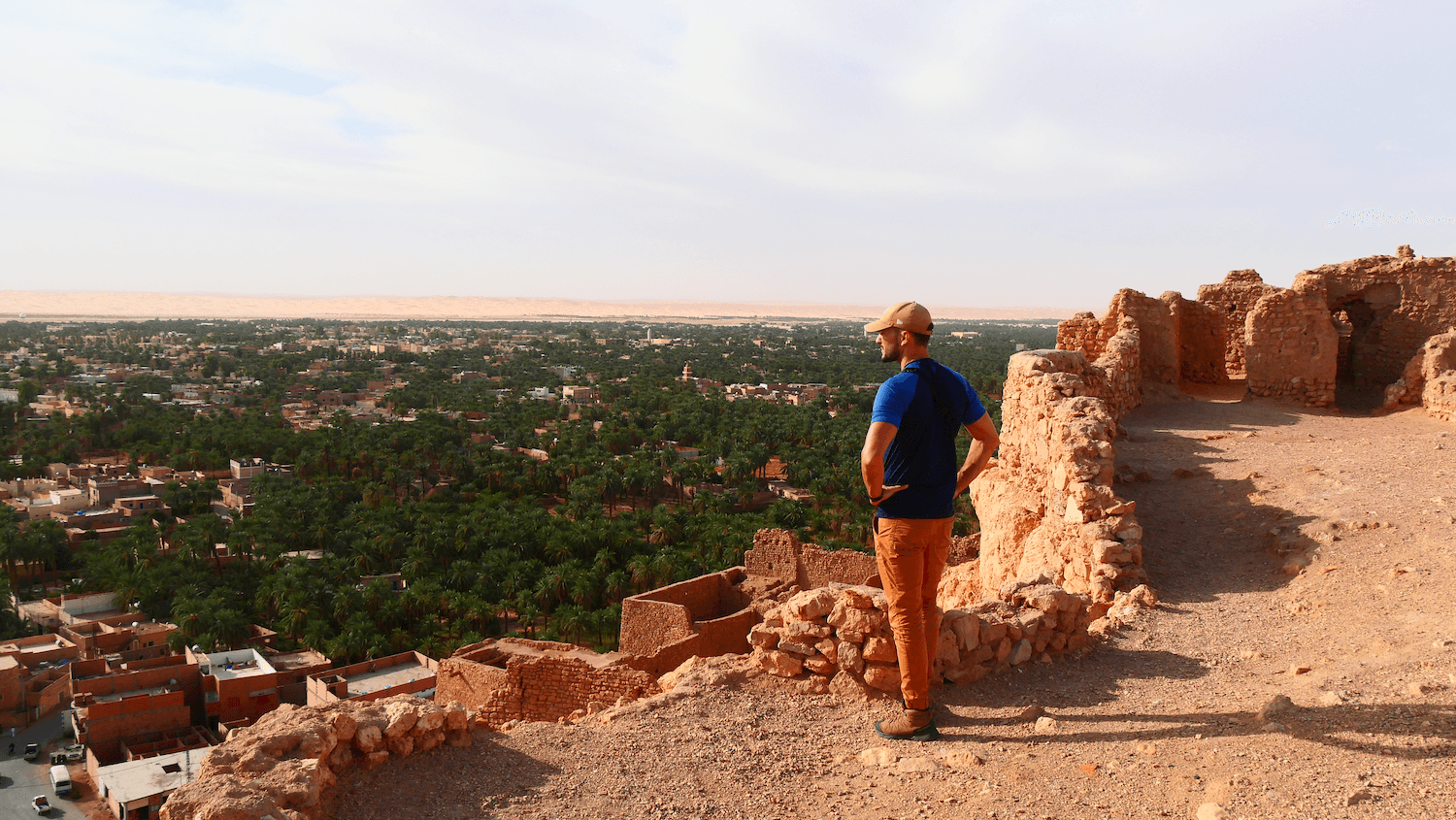
GHARDAÏA → EL GOLÉA: ON THE FIRST DUNES
Morning in Ghardaïa proper. Visit of the old town, dominated by the pyramidal minaret of the Grand Mosque of the Ksar — an imposing edifice built at the highest point of the hill, from where the desert approaches were once monitored. Strolling through the lively souk: arcaded galleries, Berber carpets, pottery, dates, spices, ironwork. Trade has always been the soul of Ghardaïa, which was for centuries a major caravan crossroads between the Sahel and the Mediterranean.
Discovery of Bounoura and Melika, which complete the pentapolis. Melika is famous for its vast terraced cemetery overlooking the valley — the aligned tombs, sober in design, create a meditative atmosphere facing the immensity of the desert.
Lunch.
Route towards the south-west in the direction of El Golé, at the beginning of the Erg Occidental. The landscape changes radically: the hammada (stony plateau) gradually gives way to the first large dunes. Arrival at El Goléa in late afternoon.
Visit of the old fortified ksar. 4×4 excursion for the sunset over the salt lake and surrounding dunes — one of the most magical moments of the journey, when the sands shift from golden to deep orange before setting the entire horizon ablaze.
Dinner and night at El Goléa.

EL GOLÉA → TIMIMOUN: IN THE FOOTSTEPS OF CHARLES DE FOUCAULD
Morning in El Goléa. Visit of the old ksar perched on its red hill, and of the chapel that houses the tomb of Father Charles de Foucauld. He was transferred here in 1929 from his hermitage in Tamanrasset where he had been assassinated in 1916. A "universal brother" as he liked to define himself, Foucauld spent the last twenty years of his life in the heart of the Hoggar, compiling the first Tuareg-French dictionary — a philological work that remains a reference today.
Early lunch.
Long drive westwards towards Timimoun, capital of the Gourara, via the Transsaharan. Magnificent landscapes of southern Erg Occidental: the alternation of regs (stony plains), dune ridges and strings of oasis palm groves that emerge around the bend of a valley bottom like so many miracles of greenery.
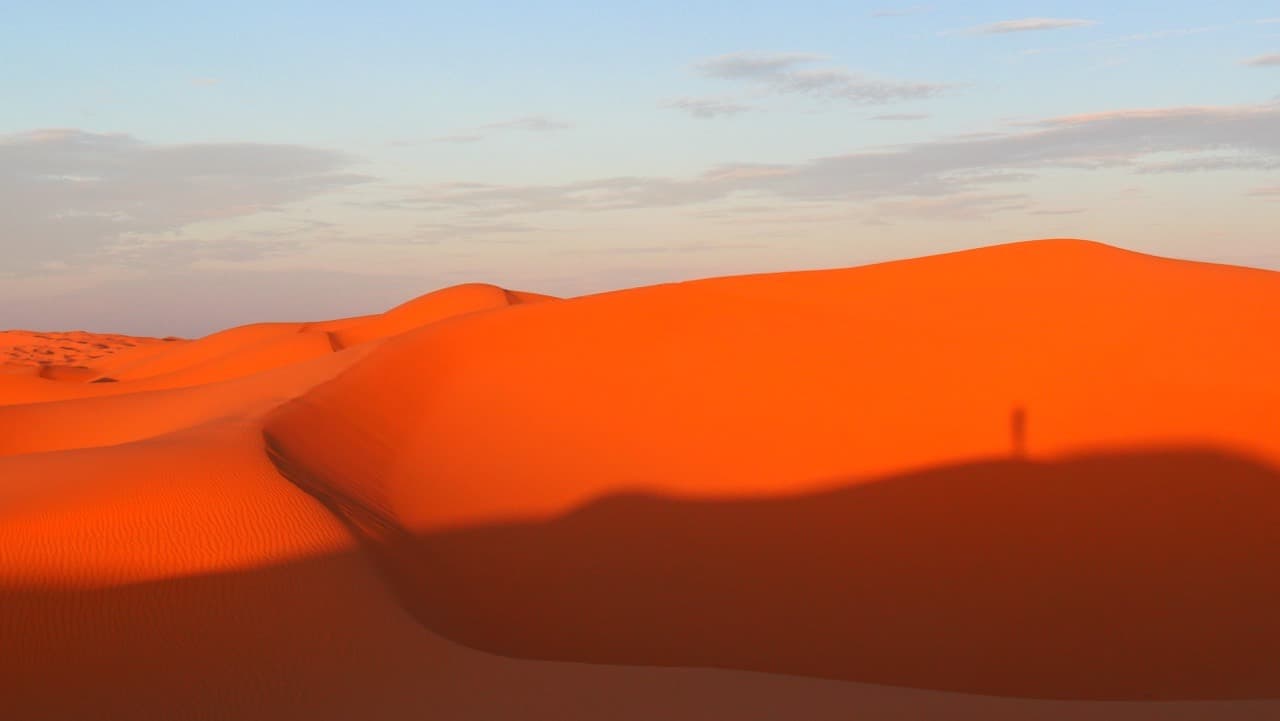
Arrival at Timimoun "the Red" in late afternoon. This is one of the strongest visual shocks of the journey: the ochre rammed earth city, positioned like a balcony above its palm grove and the sebkha (dried salt lake) that shimmers at sunset. The Sudano-Saharan architecture — crenellated facades, relief geometric patterns, doors painted with Berber motifs — gives Timimoun this unique character that evokes both Timbuktu and the ksour of the Drâa.
Check-in at a guesthouse. Dinner and overnight.
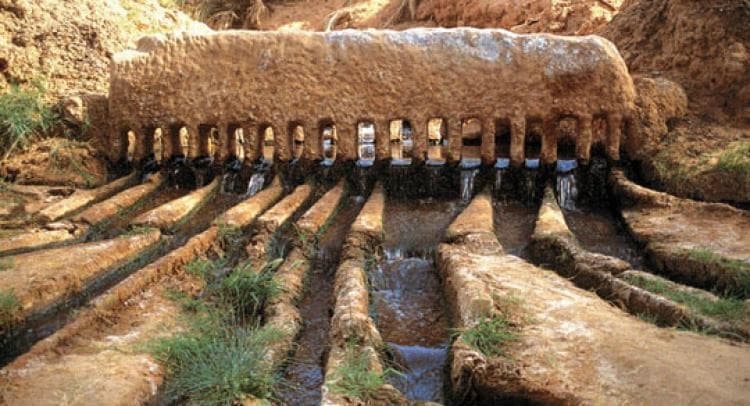
TIMIMOUN AND GOURARA: IGHZER, OULED SAÏD AND THE FOGGARA SYSTEM
Full day exploring Gourara, one of the three great oases of South-Western Algérie (along with Touat and Saoura). Early morning departure by 4×4 to the Ighzer palm grove and the village of Ouled Saïd, one of the most beautiful ksour in the region: its red earthen walls, its vaulted alleys, its sculpted mashrabiyas tell the story of a refined oasis civilization deeply rooted in its land.
Crossing the sebkha — a vast white expanse of salt, surreal in the desert light — and discovery of several red ksour perched on the dunes. Visit to the traditional system of foggaras, an ancient hydraulic engineering marvel that enables life in the desert: these underground galleries carved by hand, sometimes over several kilometres, capture water from the water tables at higher elevations and transport it by gravity down to the palm groves. The water-sharing system, managed collectively and materialized by "combs" (kasriya), is classified as UNESCO intangible cultural heritage of humanity.
Lunch under a khaïma, in the cool shade of a palm grove or at the edge of the dunes depending on the itinerary.
In the afternoon, optional: camel ride or quad tour in the dunes of the Grand Erg Occidental, or simply watching the sunset from the top of a dune — a timeless moment, where the silence of the desert is broken only by the whisper of wind through the sand.
Return to Timimoun. Dinner and overnight in a guest house.
TIMIMOUN → ALGIERS: RETURN TO THE NORTH
Morning in Timimoun. Visit to the "red castle" — the former Le Caïd hotel, built during the colonial era in pure Sudano-Saharan style and which remains the architectural emblem of the city. Discovery of the craft market (basketwork, Tuareg and Zenete jewelry, indigo fabrics), stroll through the narrow streets of the old town and along the corniche overlooking the sebkha — ultimate contemplation of this red and green landscape, ochre and blue, which exists nowhere else.
Lunch in Timimoun.
Transfer to the airport and Air Algérie flight in late afternoon to Algiers. Arrival at Houari Boumediene in early evening and transfer to the hotel near the airport. Farewell dinner and overnight stay.
Logistical note for Day 16 (Timimoun → Algiers)
Depending on Air Algérie flight schedules in effect on your travel date, the return flight to Algiers may depart from Timimoun (4 weekly rotations, direct flight of 1 hour 35 minutes — approximately 870 km) or, if necessary, from Adrar (11 weekly rotations, direct flight of 1 hour 50 minutes — approximately 1,035 km).
In this second case, an early morning road transfer Timimoun → Adrar of 220 km, approximately 2 hours 30 minutes of driving through the Touat landscapes, will be organized before boarding. This flexibility allows us to guarantee your return to the scheduled international connection, regardless of your departure date.
ALGIERS → RETURN FLIGHT TO EUROPE
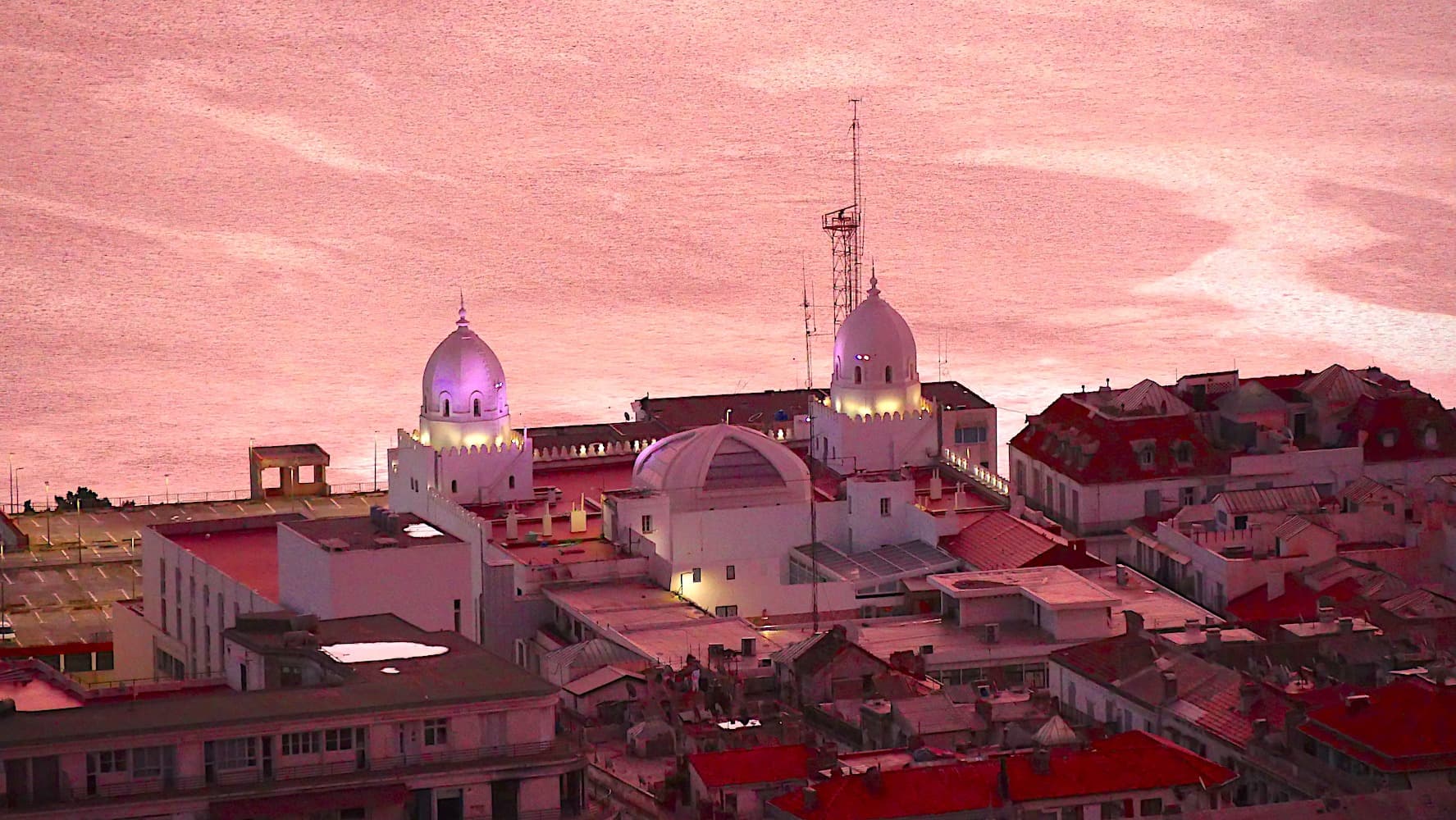
Breakfast at the hotel. Depending on your return flight schedule, free morning for last-minute shopping in downtown Algiers — the Casbah souk for leather goods, Didouche-Mourad street for pastries, or the Jardin d'Essai for a final stroll.
Transfer to Houari Boumediene international airport. Assistance with check-in and boarding procedures. Return flight to Europe.
End of our services.
Price per person
Indicative price per person, based on double room. Each trip is customized according to your preferences.
This trip can be tailored to your preferences
This itinerary provides an excellent foundation for discovery, but it can be fully customized. Our local advisors build each trip tailored to your budget, dates and preferences.
Not included
- International flights Europe → Oran and Algiers → Europe
- Algerian visa fees (≈ €185 to be paid in cash upon arrival according to current procedure)
- Individual travel insurance (cancellation, repatriation, baggage) — highly recommended
- Drinks (mineral water outside transfers, sodas, juices, wine, beers) taken during meals
- Personal expenses, telephone communications and Internet access
- Tips for the accompanying guide and driver (at your discretion, local custom)
- The options offered in the program (camel trek, quad tour in the dunes)
- Everything that is not explicitly mentioned in the "The price includes" section
Included
- Welcome and assistance upon arrival and departure at Oran and Algiers airports
- All airport / hotel / airport transfers in a private air-conditioned vehicle
- Transport throughout the circuit in a recent and air-conditioned vehicle (minibus or 4×4 depending on group size)
- 4x4 excursions in the dunes of the Grand Erg Occidental (El Goléa and Timimoun)
- Air Algérie domestic flight Timimoun → Algiers (or equivalent depending on rotation)
- Double room accommodation in the charming accommodations listed in the table above — traditional guesthouses, boutique hotels and select character hotels (16 nights)
- Full board (from dinner on Day 1 to breakfast on Day 17), excluding beverages
- The services of an English-speaking tour guide Détours Algérie throughout your entire trip
- The services of local cultural guides at major sites (Tipaza, Djemila, Constantine, Timgad, Beni Isguen)
- All entrance fees for archaeological sites, museums and monuments mentioned in the program
- Assistance with obtaining the travel permit issued by Algerian authorities (visa on arrival)
- Tips for local guides at sites
- One bottle of mineral water per day and per person during transfers
- Professional Liability Insurance for Détours Algérie
Practical Information
Registration is considered firm and final after payment of a deposit of 30% of the total price and acceptance of the specific terms of sale.
The balance must be paid no later than 45 days before the departure date.
See our specific terms of sale for full details.
In the event of cancellation by the traveller, the following fees apply:
- Plus de 60 jours avant le départ : 40 % du prix total (acompte retenu)
- Entre 60 et 30 jours avant le départ : 50 % du prix total
- Moins de 30 jours avant le départ : 100 % du prix total
We strongly recommend taking out cancellation insurance. See our specific terms of sale for full details.
The information below concerns travelers who are nationals of the European Economic Area (EEA), Switzerland, and Canada traveling to Algeria for a tourist stay. As entry rules may change, we recommend verifying this information with the official authorities before your departure.
Passport
To enter Algeria, your passport must be valid for at least six months after your date of entry into the country and have at least one blank page for immigration stamps.
The document must be in good condition (no damaged, torn, or altered pages).
Visa
Nationals of the European Economic Area, Switzerland, and Canada must be in possession of a valid visa to enter Algeria for a tourist stay. There is no visa exemption for these nationalities.
The visa must be obtained before departure, from the Algerian embassy or consulate responsible for your country of residence. It is recommended to apply several weeks in advance, as processing times may vary.
Documents generally required for a visa application include:
a valid passport with at least six months of remaining validity,
a completed and signed visa application form,
recent passport-sized photos complying with required standards,
a return flight ticket or booking,
proof of accommodation (hotel reservation or invitation),
proof of sufficient financial resources for the duration of your stay.
The authorized length of stay is generally 30 days, depending on the conditions mentioned on the visa issued.
Travel with children
Minors must be holders of their own valid passport covering the duration of their stay.
In some European countries, when a minor travels without one of their parents, an authorization to exit the territory may be required according to the regulations of their country of residence.
Health
No vaccination is officially required to enter Algeria for nationals of the EEA, Switzerland, and Canada. However, it is recommended to consult a doctor or vaccination center before departure and to ensure that basic vaccinations are up to date (diphtheria, tetanus, poliomyelitis, hepatitis A).
It is also advisable to take out international health insurance covering medical expenses and repatriation for the entire duration of your stay.
Other nationalities
Entry conditions may vary depending on nationality. Travelers concerned should inquire at the Algerian embassy or consulate of their country of residence.
To participate in our trips, it is strongly advised to have assistance-repatriation and foreign medical expenses insurance.
Your local agency encourages you to familiarize yourself with the specific policy developed with our partner CHAPKA ASSURANCES and AXA ASSISTANCE.
To subscribe to insurance, learn about coverage and rates, follow the link below.
CAP EXPLORER: The complete insurance solution designed for a worry-free trip!
Choose the plan that best suits you:
Explorer'Multirisque
Explorer'Annulation
Explorer'Assistance
Explorer' Complementary Credit Card
Specific to our trips, we strongly recommend subscribing to them.
If you choose to subscribe to one of these plans, the policy detailing all coverage and claims declaration procedures are available on the insurer's website.
Your local agency will be aware of this, but only the participant is responsible for complying with the claims declaration procedures. The participant must therefore keep this policy with them throughout their trip.
Chapka — Cap Explorer
Our insurance partnerTravel with peace of mind with our partner Chapka. Cancellation, repatriation, medical expenses, baggage… All the coverage for a worry-free trip.
Travel with peace of mind — I'll handle the insuranceFrequently asked questions
A tourist visa is required and must be requested from the consulate (consular fees apply, processing time 2-3 weeks). An invitation letter or accommodation certificate is required. Your passport must be valid for at least 6 months beyond your planned entry date. Conditions can be stringent. We strongly recommend verifying the rules applicable to your nationality with the Algerian consular authorities before booking your trip.
Go to the My Trips section to find all your projects.
You can send a message to your host directly from the Tea Lounge.
For a tailor-made quality trip, budget between 140 and 240 euros per day and per person, including accommodation, meals, internal transfers and English-speaking guide. International flights (350-700 euros return) are additional. The Algerian Sahara (Tassili, Hoggar) requires a specific budget.
Your documents are accessible in the Documents tab of your trip.
Absolutely. We adapt each itinerary to match your travel profile. For families, we prioritize relaxed paces, family-friendly accommodations, engaging and educational activities, and comfortable private transfers. Our local English-speaking guides know how to captivate children with age-appropriate stories and anecdotes.
It's simple. You exchange with our local team to define your wishes, budget and dates. You receive a detailed itinerary proposal within 48 hours. You refine every detail together until you have the perfect version. You confirm and set off with peace of mind. Your local agency remains available 7 days a week throughout your trip.
In case of emergency, contact your local agency immediately.
Payment is generally made in two installments.
Our agency is part of the Nomadays network, registered in France. You benefit from APST guarantee (Professional Association of Tourism Solidarity) which covers 100% of your funds. Secure payment, repatriation insurance included, and English-speaking assistance 24/7 on site throughout your stay.

Let's talk about your adventure — Western Oran
Pioneer of Algeria's great deserts, based in Ghardaïa / M'zab (puis Alger à partir de 2006)
The desert is not crossed with an itinerary alone. It demands listening, respect, and a certain inner availability.
— Louiza